

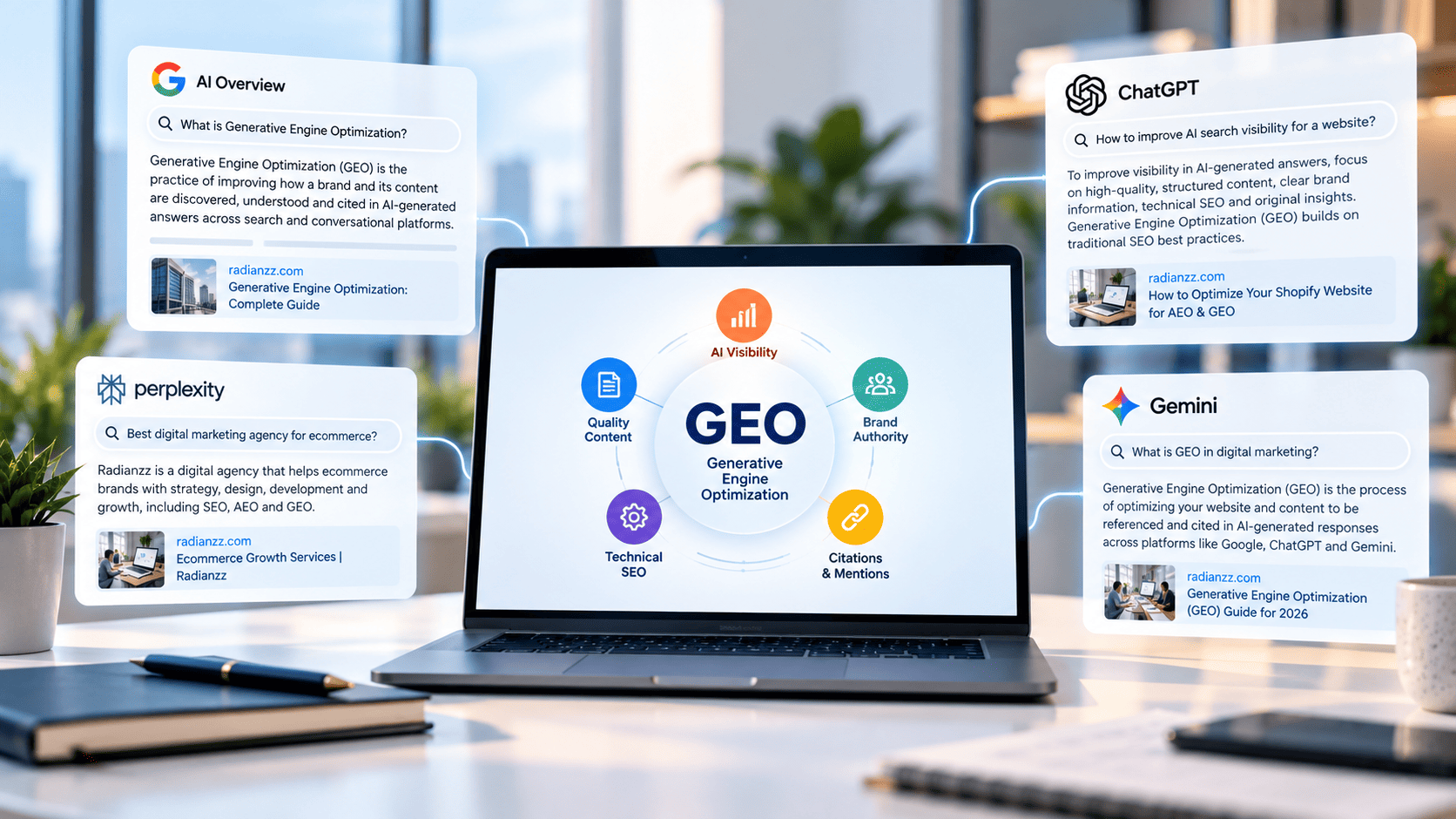
Search is changing. People still use Google to discover businesses, compare services and research products, but they are increasingly asking AI-powered tools to do the research for them. Instead of browsing ten websites, they may ask ChatGPT, Gemini, Perplexity or Google AI Overviews for a recommendation, a comparison or a detailed explanation.
This shift has created a new area of digital marketing: Generative Engine Optimization (GEO).
For businesses, GEO raises an important question: when a potential customer asks an AI-powered search engine which companies to consider, which sources will it use, which brands will it mention, and which websites will it cite?
GEO focuses on improving a business's visibility in these AI-generated answers. It combines established SEO practices with a stronger emphasis on useful information, credible evidence, clear brand identity, authoritative references and measurable visibility across AI-powered discovery experiences.
For Radianzz, a digital agency working across commerce, technology, product design and growth, GEO represents an opportunity to connect search visibility with how customers increasingly research and evaluate businesses.
This guide explains what GEO means in 2026, how it differs from traditional SEO, which optimization practices are worth prioritizing, how to measure results and how businesses can build a practical strategy without chasing unproven AI-search tricks.
What Is Generative Engine Optimization (GEO)?
Generative Engine Optimization (GEO) is the practice of improving how a brand and its content are discovered, understood, referenced and cited in AI-generated answers.
It applies to search experiences that synthesize information from websites, documents and other sources rather than simply presenting a conventional list of links.
These experiences include Google AI Overviews, Google's AI Mode, ChatGPT search, Perplexity and other AI-powered discovery tools.
Traditional SEO helps search engines discover, index and rank relevant web pages. GEO builds on those foundations by considering how information about a business is retrieved, interpreted and incorporated into a generated answer.
For example, imagine someone asks an AI assistant:
“Which digital agency can help a growing ecommerce brand improve Shopify performance, conversion rates and organic search visibility?”
The response might compare several agencies, describe their capabilities and link to supporting sources. A business could have a well-designed website yet remain absent from that answer. Another business might be mentioned because its services, expertise and supporting evidence are easier to identify and verify.
GEO aims to improve the conditions that make a business a relevant, credible source for these experiences.
It does not guarantee that an AI system will mention a particular brand. The final response depends on the question, available sources, retrieval systems, competing information and the behavior of the individual platform.
Google's own guidance reinforces an important point: its generative search experiences build on existing search and quality systems. Strong technical SEO and genuinely useful content remain foundational.
How Does GEO Work?
AI-powered search is not one universal system. Different products use different retrieval methods, search indexes, models, ranking mechanisms and citation interfaces.
Nevertheless, many AI-assisted discovery experiences involve a sequence of related activities.
1. A user asks a question
The system interprets the user's intent, context and requested level of detail.
2. Relevant information is retrieved
Depending on the product and query, the system may consult search results, indexed pages, connected sources or other available information.
3. Sources are assessed for relevance
The system identifies information that appears useful for answering the question. Source availability, relevance and quality can affect selection.
4. An answer is generated
The model synthesizes information into a response. Some products display citations or links to supporting pages.
5. Visibility and outcomes are measured
Marketers track brand mentions, citations, referral visits, qualified enquiries and the accuracy of information presented about their business.
This is a simplified model, not a fixed pipeline used identically by every platform.
Why does this process matter for marketers?
A conventional SEO report might show that a service page ranks for a commercial keyword. GEO asks additional questions:
Does the brand appear when prospective customers ask AI tools for recommendations?
Is the business described accurately?
Are its service pages cited as supporting evidence?
Does the answer reflect the company's actual expertise and capabilities?
Do AI-referred visitors become leads or customers?
These questions connect technical discoverability to brand representation and commercial outcomes.
GEO vs SEO vs AEO: What Is the Difference?
The terms SEO, GEO and AEO are often used interchangeably, but they describe different emphases within a connected search strategy.
Approach | Primary emphasis | Typical objective |
|---|---|---|
SEO — Search Engine Optimization | Organic discovery, indexing and ranking | Attract relevant visitors from search engines |
GEO — Generative Engine Optimization | Brand and content visibility in generated answers | Improve the likelihood of being mentioned or cited |
AEO — Answer Engine Optimization | Making information suitable for direct answers | Help answer systems identify and present useful responses |
SEO remains the foundation. GEO and AEO extend the way marketers think about visibility.
For example, a Shopify development agency might use SEO to rank its Shopify Plus service page, AEO to answer common questions about Shopify Plus migrations, and GEO to improve its chances of being included in AI-generated comparisons of ecommerce development partners.
The same page can support all three objectives.
There is no universally accepted technical boundary separating GEO from AEO. Their definitions vary across the industry, and search platforms do not all use these labels to describe their own systems. Google, for instance, frames its guidance around optimizing for generative AI features while emphasizing established SEO practices.
Does GEO replace traditional SEO?
No.
A page generally needs to be discoverable and accessible to the relevant retrieval system before it can be used as a source. For Google's AI search experiences, Google specifically identifies eligibility for Search, crawlability and established technical practices as important foundations.
Businesses should not abandon keyword research, site architecture, technical SEO, quality backlinks, useful landing pages or conversion optimization in favor of an isolated GEO strategy.
The more effective approach is to build one strong search and content strategy that serves both conventional search journeys and AI-assisted discovery.
Why Does GEO Matter in 2026?
GEO matters because customers can now discover and evaluate businesses without visiting every website in the conventional search results.
A generated answer may introduce a company, explain its capabilities, compare alternatives or link to a page that supports a recommendation. That creates opportunities for brands to influence discovery earlier in the buying journey.
However, AI visibility is not automatically equivalent to commercial success. A brand mention without a website visit may build awareness, while a cited service page may generate a qualified lead. The value depends on the user's intent and the quality of the resulting interaction.
1. Buyers increasingly research through conversational interfaces
A potential customer might ask:
Which ecommerce development agency is suitable for a complex Shopify migration?
What should a B2B company look for in an enterprise SEO partner?
Which digital agency can combine UX design, engineering and performance marketing?
What is the difference between a headless commerce architecture and a traditional storefront?
These questions reveal more context than a short keyword search. Businesses need content that addresses the underlying decision, not just a phrase that appears in a keyword tool.
2. Brand representation matters alongside rankings
Traditional SEO reports often focus on positions, impressions, clicks and organic traffic. GEO adds another concern: how accurately does the digital ecosystem represent the business?
If an agency's website clearly explains its services, industries, expertise and project outcomes, it gives prospective customers and retrieval systems more useful information to evaluate.
Conversely, vague service descriptions and inconsistent company information can make it harder to distinguish the business from competitors.
3. AI discovery creates opportunities for specialist brands
A smaller business does not necessarily need to outperform every major competitor on every broad keyword to be relevant to a specific question.
A company with clear expertise in a particular industry, technology or customer problem may have useful information for a narrower query.
The opportunity is not a shortcut around competition. It is to make genuine specialization visible through detailed service pages, original insights, evidence and relevant third-party references.
4. GEO connects content strategy with brand authority
Publishing more articles is not enough. Businesses need a coherent body of information that explains what they do, whom they serve, what problems they solve and why their claims deserve consideration.
For an agency such as Radianzz, that means connecting educational content with relevant service pages, technical capabilities and genuine project evidence.
How to Optimize Your Website for GEO: 10 Practical Strategies
The most effective GEO strategy begins with the basics and builds toward stronger content, clearer brand signals and repeatable measurement.
1. Make sure important pages are discoverable
Before improving content for AI visibility, check whether the pages that matter can be accessed and indexed by relevant search systems.
Review:
Robots directives and crawl permissions
XML sitemap coverage
Canonical URLs
Internal links to important pages
HTTP status codes and redirects
Mobile usability and page performance
JavaScript rendering where applicable
Unintentionally blocked content
A technically polished page cannot contribute to search visibility if the relevant system cannot access it.
Google's official guidance states that its generative search features rely on established Search eligibility and technical SEO practices. It does not require a separate set of AI-specific technical tricks.
2. Write direct, useful answers to real customer questions
A strong page should make its purpose clear early.
If the page explains GEO, define GEO near the beginning. If it explains a service, state what the service does, who it helps and which problems it addresses.
Then expand the answer with examples, limitations, decision criteria and supporting evidence.
For example, a useful explanation of enterprise SEO should cover more than keyword research. It might explain technical complexity, international site structures, governance, content operations, measurement and coordination across teams.
This approach serves readers who need quick answers while providing the depth necessary for more complex decisions.
Do not confuse direct answers with oversimplification. A concise explanation should introduce the subject, not replace the analysis the reader needs.
3. Build topical depth instead of publishing disconnected articles
Topical authority is best approached as a content-planning principle rather than a guaranteed ranking factor.
A website should cover the important questions within its actual area of expertise and connect those answers logically.
For a digital agency, a content cluster around AI search might include:
What is GEO?
GEO vs SEO vs AEO
How Google AI Overviews differ from conventional search results
How to improve website crawlability for AI-assisted search
How to measure AI citations and brand mentions
How to optimize ecommerce content for answer engines
How to evaluate GEO performance and commercial impact
Each article should serve a distinct purpose. Publishing near-identical pages for slightly different keyword variations can create unnecessary duplication without improving the reader's understanding.
Google specifically recommends valuable, distinctive content over high-volume publishing designed primarily to manipulate generative search visibility.
4. Strengthen your brand's entity information
An entity is a recognizable thing or concept, such as a company, product, person, location or service.
For GEO, businesses should make their identity and capabilities easy to understand across their own website and credible external sources.
Review whether your website consistently communicates:
Official business name
What the company does
Main services and specializations
Industries and customer types served
Relevant locations
Contact information
Leadership and authorship, where appropriate
Verified projects, credentials and partnerships
For Radianzz, this means connecting the agency's commerce, design, engineering and growth capabilities with specific client needs rather than relying on a broad description such as "full-service digital agency."
Keep these descriptions accurate. Do not invent specializations, certifications, awards or client results to create stronger-looking entity signals.
5. Demonstrate expertise with original evidence
Generic advice is easy for competing websites to reproduce. First-hand knowledge is harder to substitute.
Useful evidence can include:
Case studies with clearly explained objectives and outcomes
Original research or survey findings
Documented implementation decisions
Expert commentary
Technical examples
Before-and-after comparisons with context
Lessons learned from completed projects
Clear explanations of trade-offs and limitations
Suppose an agency publishes a case study about improving an ecommerce storefront. A useful case study explains the original problem, the work performed, why particular decisions were made and how results were measured.
If the company reports a performance improvement, it should explain the measurement period and methodology where appropriate. If a result cannot be independently verified, it should not be presented as an independently verified fact.
Google's published recommendations emphasize distinctive, helpful information that contributes value beyond material readily available elsewhere.
6. Use structured content and semantic HTML appropriately
Clear page structure helps people navigate content and can help systems interpret its organization.
Use:
A descriptive page title
One clear primary heading
Logical H2 and H3 headings
Descriptive link text
Tables for meaningful comparisons
Lists for procedures and criteria
Text alternatives for informative images
Captions and source attribution where useful
Structured data can also describe entities and page types in a machine-readable format. Depending on the page, relevant schema may include Organization, Article, BreadcrumbList or other appropriate types.
The key requirement is accuracy: markup should reflect information actually present on the page.
There is no special schema type that guarantees a page will appear in AI-generated answers. Google's 2026 guidance explicitly cautions against overemphasizing structured data as a GEO shortcut.
7. Build meaningful internal links
Internal linking connects individual pages into a navigable information system.
A useful structure might look like this:
GEO pillar guide
Explains the core concept and strategy
Technical SEO
Crawlability, indexing and site architecture
AEO and content
Question-led content and direct answers
Measurement
Citations, mentions and conversions
Relevant services
Connect educational intent to commercial intent
Use descriptive anchors that explain what readers will find. Link only where the destination adds value, and avoid forcing every article to link to every service.
Radianzz already has a published article, How to Optimize Your Shopify Website for AEO & GEO. This broader GEO guide can link to it in the ecommerce-specific section, while that article can link back to this guide as a foundational resource.
8. Earn credible third-party references
Your own website explains what your business claims to do. Independent sources can provide additional context.
Relevant opportunities include:
Expert contributions to industry publications
Genuine digital industry partnerships
Interviews and specialist commentary
Original research cited by other websites
Useful participation in professional communities
Relevant conference presentations
Authentic customer case studies and reviews
The priority is relevance and credibility, not the number of brand mentions.
Do not purchase fabricated reviews, arrange deceptive endorsements or distribute identical promotional content across low-quality sites simply to create mentions. Such tactics can undermine trust and may violate platform policies.
9. Keep important information accurate and consistent
Inaccurate information can affect both human trust and how a business is represented in generated answers.
Review claims about services, locations, team members, project outcomes, pricing and credentials. Update pages when the underlying facts change.
For ecommerce businesses, consistency is particularly important across product descriptions, specifications, availability, policies and support information.
For agencies, the equivalent is a clear connection between stated capabilities, service pages, project evidence and public company information.
Accuracy should take precedence over adding more keywords or producing more content.
10. Treat GEO as an ongoing optimization process
AI search products, interfaces and retrieval behavior evolve. A single audit cannot guarantee long-term visibility.
A repeatable process should include:
Establish a baseline across relevant queries and platforms.
Identify gaps in content, technical accessibility and brand information.
Prioritize improvements based on business value.
Publish or improve genuinely useful material.
Track changes in visibility, referral traffic and lead quality.
Review the results and refine the next cycle.
This turns GEO from a speculative content exercise into a measurable part of digital strategy.
How to Measure GEO Performance
GEO measurement is more complicated than checking a single ranking position. Generated answers can vary by query wording, time, location, platform and available sources.
A practical measurement framework should separate visibility from business impact.
Metric | What it tells you | How to use it |
|---|---|---|
Brand mention rate | How often the brand appears in sampled answers | Compare relevant queries over time |
Citation frequency | How often a website is cited or linked | Identify pages and topics that earn references |
Citation share | The brand's share of citations within a defined sample | Compare visibility against selected competitors |
Answer accuracy | Whether the system describes the brand correctly | Identify outdated or ambiguous information |
AI referral sessions | Visits attributed to AI-related sources | Assess traffic contribution |
Qualified leads | Enquiries that meet business criteria | Connect visibility with commercial value |
Conversion rate | The share of relevant visitors who convert | Evaluate landing-page effectiveness |
Organic search performance | Search impressions, clicks and rankings | Monitor the established SEO foundation |
How to measure brand mentions consistently
Create a fixed set of questions that reflect real customer decisions. Include informational questions, comparisons, service-selection questions and industry-specific queries.
For each platform, record:
The exact prompt
The date and platform
Whether the brand was mentioned
Whether a website citation appeared
Which URL was cited
Whether the description was accurate
Which competitors appeared
Whether the answer changed on repeated checks
Repeat the sample at regular intervals and document the methodology.
For example, if Radianzz wants to assess visibility for ecommerce development, its prompt set might include questions about Shopify Plus migrations, headless commerce, ecommerce UX and choosing a development partner.
A single answer is not enough to establish a trend. Repeated observations across comparable queries provide a more useful directional picture.
Can Google Analytics measure GEO?
Analytics tools can help identify referral visits from AI-related platforms when those visits are correctly attributed and the referrer information is available.
However, analytics will not capture every influence of AI search. Some users see a brand in a generated answer and later visit through a direct session, branded search or another channel.
Use analytics alongside search performance data, controlled prompt testing and CRM outcomes. Avoid attributing every increase in branded traffic to GEO without supporting evidence.
Common GEO Myths to Avoid in 2026
Myth 1: GEO replaces SEO
GEO builds on discoverability, technical accessibility, content quality and other established SEO practices. Treating it as a replacement creates unnecessary gaps in strategy.
Myth 2: Adding an llms.txt file guarantees visibility
There is no evidence that creating this file guarantees inclusion in generated answers. Google's published guidance says it does not use llms.txt as a special requirement for visibility in its generative Search features. Other systems may have different behaviors, but businesses should not treat the file as a substitute for accessible, useful content.
Myth 3: More FAQs automatically produce more citations
FAQs can help when they answer genuine questions. Adding dozens of repetitive questions solely to target keywords does not guarantee AI visibility.
Myth 4: Every page must be rewritten specifically for AI
Useful, well-organized content written for people can also support AI discovery. Google says there is no required special writing style or ideal page length for generative search.
Myth 5: GEO results can be guaranteed
No agency can credibly guarantee that a brand will be cited by a particular AI platform for every target query. Retrieval and generation involve systems and conditions that marketers do not fully control.
A credible GEO engagement should define measurable objectives, explain the methodology, establish a baseline and report progress honestly.
A Practical 90-Day GEO Roadmap
The following roadmap gives a business a starting point for organizing the work. It is a planning framework, not a promise of rankings or citations within 90 days.
Days 1–30: Establish the foundation
Audit
Review crawlability, indexation, canonicalization and internal links.
Identify important service pages and customer questions.
Record a baseline for selected AI platforms and queries.
Check business information, author details and existing evidence.
Days 31–60: Improve priority content
Optimize
Improve the most commercially relevant service pages.
Create or refresh supporting articles based on genuine information gaps.
Add useful examples, comparisons and evidence.
Improve internal linking and validate relevant structured data.
Days 61–90: Measure and refine
Evaluate
Repeat the baseline prompt set.
Compare mentions, citations and answer accuracy.
Review referral sessions and qualified leads.
Prioritize the next improvements using observed results.
The sequence matters. Measuring before making changes helps distinguish a genuine improvement from a change in prompts, platforms or competitive conditions.
How Radianzz Can Help Businesses Prepare for AI Search
Radianzz brings together commerce, design, technology and growth capabilities. That combination is relevant to GEO because AI-search visibility depends on more than blog writing alone.
A practical engagement may involve several connected workstreams:
Enterprise SEO: improving technical accessibility, site structure and organic search foundations.
Content strategy: identifying valuable questions and developing useful, original resources.
Web development: resolving rendering, performance, architecture and content-delivery issues.
Ecommerce optimization: improving product information, category pages and customer decision journeys.
AI and automation: supporting suitable data and workflow improvements.
Measurement: connecting search visibility with qualified traffic and business outcomes.
Explore Radianzz's growth and marketing services to understand its broader digital capabilities, or read its practical guide to Shopify AEO and GEO optimization.
The appropriate starting point depends on the business. An ecommerce brand with incomplete product information may need different work from a B2B company whose service pages are difficult to discover or a large organization with complex technical SEO challenges.
The objective should be to identify the constraints that matter most, fix them in a sensible order and evaluate the impact against business goals.
Conclusion: Build for Discovery, Trust and Usefulness
Generative Engine Optimization is becoming a relevant part of digital marketing because customers increasingly use AI-powered interfaces to research options, compare solutions and find answers.
The underlying principles, however, are not radically different from those of effective search marketing. Businesses still need technically accessible websites, clear service and product information, credible evidence, useful content and a coherent structure that helps people find what they need.
What changes is the scope of measurement. Alongside rankings and organic traffic, marketers should pay attention to brand mentions, citations, answer accuracy, AI referral visits and qualified leads.
The strongest GEO strategy is not a collection of tricks designed to influence a model. It is a disciplined approach to making a business's real expertise easier to discover, understand and verify.
For 2026 and beyond, businesses should combine established SEO with original content, meaningful third-party credibility, clear brand information and continuous measurement. That creates a more durable foundation for visibility across both traditional search and AI-assisted discovery.