
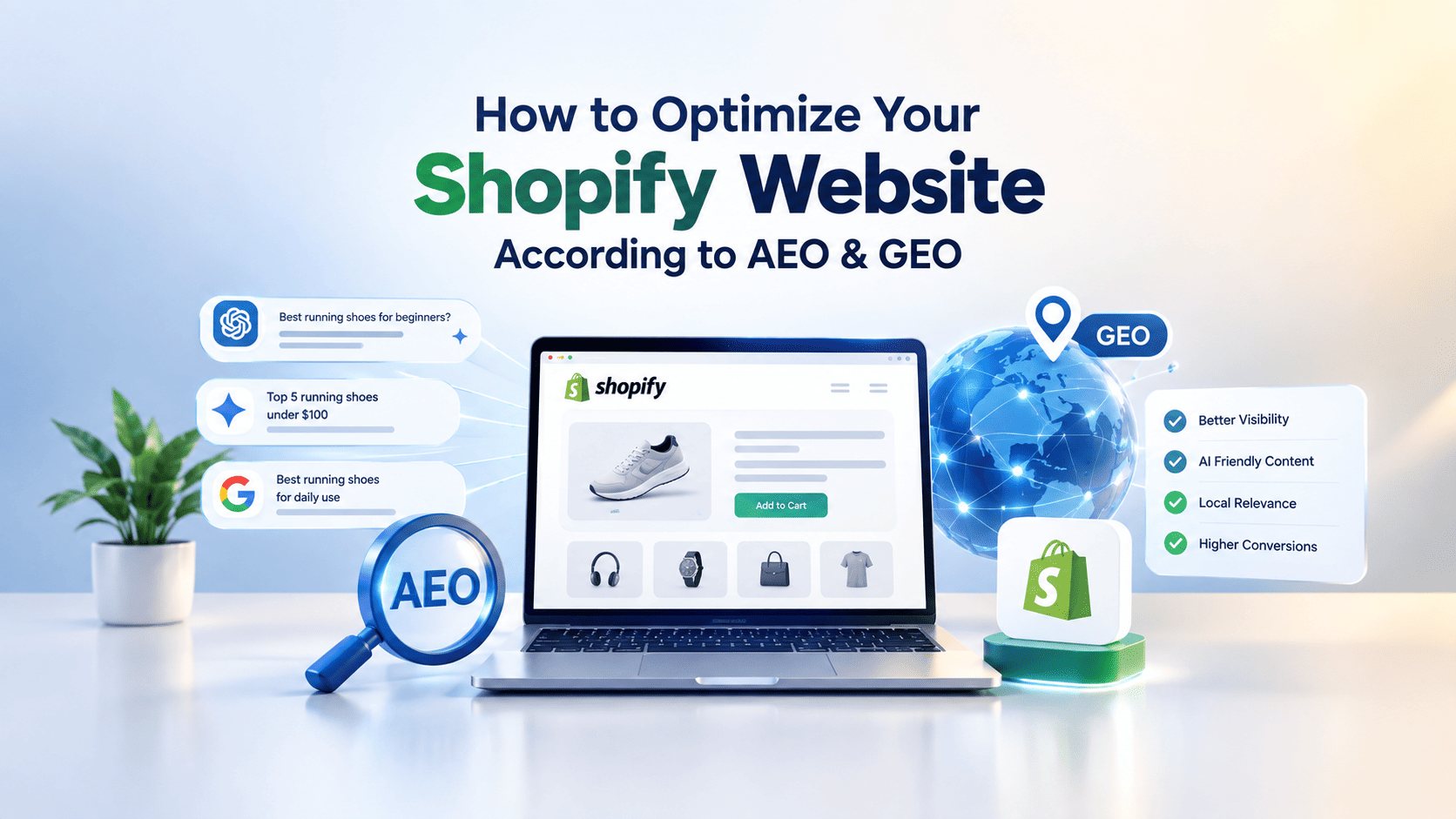
Search is changing.
For years, Shopify businesses focused primarily on ranking product pages, category pages, collections, and blog articles in traditional search results.
The objective was straightforward:
Rank higher → receive more clicks → generate more traffic → increase sales.
But the search journey is becoming increasingly complex.
Customers now ask questions through AI-powered experiences and expect direct answers rather than simply a list of blue links.
They may ask:
"What is the best Shopify store for sustainable running shoes?"
"Which Shopify brands sell premium skincare products?"
"What are the best alternatives to [product]?"
"Which ecommerce platforms are suitable for B2B commerce?"
"Compare these three products for a small business."
Search engines and AI platforms increasingly need to understand the meaning, context, relationships, credibility, and usefulness of information across websites.
This creates an important opportunity for Shopify businesses.
Traditional SEO remains important, but ecommerce brands should increasingly consider Answer Engine Optimization (AEO) and Generative Engine Optimization (GEO) as part of their broader search strategy.
A Shopify website that is technically accessible, semantically structured, entity-rich, authoritative, and genuinely useful gives search and AI systems more information to understand and potentially surface.
What Are AEO and GEO?
What Is Answer Engine Optimization?
Answer Engine Optimization (AEO) focuses on structuring website content so that it can effectively answer questions users ask through search engines and answer-oriented interfaces.
Traditional SEO might target:
"Shopify Plus development company"
AEO expands the strategy toward questions such as:
"What does a Shopify Plus development company do?"
"When should an enterprise migrate to Shopify Plus?"
"How much does Shopify Plus development cost?"
"What are the benefits of Shopify Plus for enterprise ecommerce?"
The objective is to provide clear, useful answers that directly address search intent.
What Is Generative Engine Optimization?
Generative Engine Optimization (GEO) focuses on improving the likelihood that a brand's information can be understood, retrieved, and represented within AI-generated search experiences.
These may include:
Google AI-powered search experiences
ChatGPT
Gemini
Perplexity
Other generative search interfaces
GEO requires thinking beyond individual keywords.
AI systems need to understand:
Who you are
What your business does
What products you sell
Who you serve
What topics you have expertise in
How your products relate to customer needs
Why your information is credible
That makes semantic relevance, entities, authority, structured information, and content quality increasingly important.
Why AEO & GEO Matter for Shopify Websites
A Shopify website contains many different information types.
For example:
Products
Collections
Brands
Categories
Reviews
Blog articles
FAQs
Buying guides
Policies
Company information
Customer support content
Traditional SEO can optimize these individual pages.
AEO and GEO require Shopify businesses to think about how these pages collectively communicate the meaning and expertise of the entire website.
For example, an ecommerce brand selling professional skincare products shouldn't only publish product pages.
It can build a connected information ecosystem around:
Skincare ingredients
Skin types
Product selection
Product comparisons
Usage instructions
Ingredient safety
Routines
Common customer questions
Buying guides
This creates stronger topical relationships.
Shopify AEO & GEO Optimization Strategies
1. Understand the Questions Your Customers Ask
AEO begins with questions.
Instead of only researching keywords, identify the questions customers ask before, during, and after purchasing.
These can include:
Informational Questions
What is this product?
How does it work?
What are its benefits?
Comparison Questions
Product A vs Product B
Which product is better for beginners?
Which solution is best for enterprise businesses?
Commercial Questions
How much does it cost?
Where can I buy it?
Is it worth the investment?
Transactional Questions
How do I purchase?
What payment methods are available?
How quickly can it be delivered?
Post-Purchase Questions
How do I use the product?
How do I return it?
How do I maintain it?
Organizing content around these question categories creates a more complete customer information journey.
2. Create Direct Answers Within Your Shopify Content
One of the most effective AEO principles is clarity.
Don't bury the answer underneath several paragraphs of introductory content.
When addressing an important question, provide a concise answer first and then expand upon it.
For example:
What Is Shopify Plus?
Shopify Plus is Shopify's enterprise commerce platform designed for high-growth and complex merchants requiring advanced capabilities, automation, customization, and scalability.
The following sections can then explain:
Features
Benefits
Use cases
Limitations
Costs
Migration considerations
This structure makes information easier to understand for both humans and machines.
3. Build Question-Based Content Around Search Intent
Your Shopify blog should not exist simply to publish articles.
It should answer meaningful customer questions.
Instead of creating an article targeting only:
"Shopify SEO"
build content around questions such as:
How do you improve Shopify SEO?
How does Shopify technical SEO work?
How do Shopify collection pages rank?
How can Shopify stores improve Core Web Vitals?
How do you optimize Shopify product pages?
This allows one topic to address multiple related search intents.
4. Strengthen Shopify Product Page Content
Product pages are extremely important for ecommerce AEO and GEO.
A product page should clearly communicate:
Product name
Product type
Brand
Key features
Benefits
Specifications
Variants
Materials
Dimensions
Compatibility
Usage instructions
Pricing
Availability
Shipping information
Returns
FAQs
Avoid relying solely on manufacturer descriptions.
Develop original product information that helps customers make decisions.
The more complete the product context, the easier it becomes for search systems to understand what the product actually represents.
5. Optimize Shopify Collection Pages
Collection pages often represent valuable commercial search opportunities.
However, many Shopify stores use collection pages primarily as product grids.
That creates a missed opportunity.
A strong collection page can include:
Descriptive introduction
Category definition
Selection guidance
Key benefits
Product attributes
Buying considerations
FAQs
Internal links
Supporting educational content
For example, a collection page targeting:
"Running Shoes for Beginners"
could explain:
What beginner runners should consider
Cushioning requirements
Shoe types
Fit considerations
Common mistakes
Recommended products
Related buying guides
This creates useful context around the products.
Make Your Shopify Website Entity-Friendly
Define Your Brand Entity
AI systems need to understand what your business represents.
Your website should clearly establish:
Brand name
Business description
Industry
Products
Services
Locations
Target audience
Expertise
Contact information
Maintain consistency across your website and relevant external business profiles.
Strengthen Product Entities
Products should have consistent information across:
Product titles
Descriptions
Images
Specifications
Reviews
Structured data
Category relationships
Avoid creating contradictory product information across different pages.
Consistency improves understanding.
Establish Topic Relationships
Your Shopify website should demonstrate relationships between entities and topics.
For example:
Brand → Product → Category → Ingredient → Use Case → Customer Need
This semantic structure helps establish context around your offerings.
Use Structured Data on Your Shopify Website
Structured data helps communicate information about your pages in a machine-readable format.
Depending on your Shopify implementation, relevant structured data can include:
Product
Offer
Review
AggregateRating
Organization
Breadcrumb
Article
FAQPage
Structured data should accurately represent the visible content on the page.
It should not be used to mark up information that isn't actually present.
For ecommerce websites, accurate product information is particularly important.
Build Topical Authority Around Your Shopify Store
AEO and GEO shouldn't be limited to product pages.
Your Shopify website should demonstrate expertise around the subjects your customers care about.
For example, a premium coffee brand could create content around:
Coffee beans
Roasting
Brewing methods
Grind size
Coffee equipment
Storage
Flavor profiles
Origin
Buying guides
This creates a broader knowledge ecosystem around the products.
The goal isn't to publish hundreds of low-value articles.
The goal is to create high-quality topical depth.
Create Strong Internal Linking Relationships
Internal linking helps users and search systems navigate your website.
A Shopify content ecosystem might look like:
Pillar Guide
↓
Supporting Articles
↓
Collection Page
↓
Product Page
↓
Related Product
For example:
Ultimate Guide to Running Shoes
could link to:
Best running shoes for beginners
Road vs trail running shoes
How to choose running shoe size
Running shoe cushioning guide
Running shoes collection
Individual product pages
This creates logical relationships between information and commerce pages.
Optimize Shopify Content for Conversational Search
Customers increasingly search using natural language.
Traditional:
"best running shoes women"
Conversational:
"What are the best running shoes for women who run three times a week?"
Your content should naturally address conversational questions.
Useful formats include:
FAQs
How-to guides
Comparisons
Definitions
Buying guides
Troubleshooting content
Expert explanations
Don't artificially insert conversational keywords.
Answer the underlying question naturally.
Strengthen E-E-A-T Signals
AEO and GEO require more than content volume.
Businesses should demonstrate credibility.
Strengthen expertise through:
Author information
Expert contributors
Original research
First-hand experience
Case studies
Product testing
Customer reviews
Transparent company information
Citations to authoritative sources where appropriate
For ecommerce brands, first-hand product knowledge can be especially valuable.
Explain how products work, who they are suitable for, and what customers should consider before purchasing.
Optimize Shopify Technical SEO for AI Discovery
AEO and GEO do not eliminate technical SEO.
The foundation still matters.
Improve Crawlability
Ensure important pages can be discovered and crawled.
Pay attention to:
Internal links
XML sitemaps
Robots directives
Canonical URLs
Navigation
Orphan pages
Control Duplicate Content
Shopify stores can generate multiple URLs and page variations.
Review:
Product URLs
Collection URLs
Filtered URLs
Pagination
Parameter variations
Canonicalization
Improve Page Performance
Optimize:
Images
JavaScript
CSS
Fonts
Third-party applications
App scripts
Lazy loading
Performance remains important for users and search visibility.
Optimize Shopify FAQs for AEO
FAQs are particularly useful when they answer genuine customer questions.
Good FAQ topics can include:
Product compatibility
Shipping
Returns
Pricing
Product usage
Maintenance
Sizing
Availability
Warranty
Comparisons
Each question should have a direct and useful answer.
Avoid creating FAQs simply to insert keywords.
The goal is to resolve customer uncertainty.
Build Content That AI Systems Can Understand and Trust
AI systems need usable information.
That means your content should be:
Clear
Avoid unnecessary complexity.
Specific
Provide concrete information rather than vague marketing statements.
Consistent
Maintain consistent facts across your website.
Structured
Use logical headings and sections.
Comprehensive
Answer the important questions surrounding the topic.
Evidence-Based
Support important claims with credible evidence where appropriate.
Original
Provide genuine expertise rather than rewriting information already available everywhere.
This is especially important for competitive ecommerce categories.
Common Shopify AEO & GEO Mistakes to Avoid
Publishing Keyword-Stuffed Content
Repeating keywords does not automatically improve AI visibility.
Focus on meaning and usefulness.
Creating Hundreds of Thin Articles
More content does not automatically create more authority.
Prioritize depth and relevance.
Ignoring Product Information
AI systems need detailed product context.
Thin product descriptions create weak information signals.
Using Generic Manufacturer Descriptions
Duplicate descriptions provide little differentiation.
Create original product content.
Ignoring Internal Linking
Disconnected content makes it harder to understand relationships between topics and products.
Treating FAQs as Keyword Containers
FAQs should answer genuine customer questions.
Neglecting Technical SEO
Poor crawlability and indexation can prevent valuable content from being discovered.
Making Unsupported Claims
Statements about product performance, results, rankings, or benefits should be accurate and defensible.
How to Measure Shopify AEO & GEO Performance
AEO and GEO require broader measurement than traditional rankings.
Track:
Traditional SEO Metrics
Organic traffic
Keyword visibility
Rankings
Impressions
Click-through rate
Indexed pages
Conversion Metrics
Product conversions
Revenue
Average Order Value
Conversion rate
Customer Acquisition Cost
Content Metrics
Organic entrances
Engagement
Scroll depth
Assisted conversions
Internal link engagement
AI Search Visibility
Where measurable, monitor:
Brand mentions
Product mentions
Citation visibility
AI-generated recommendations
Search-answer inclusion
Referral traffic from AI platforms
AI visibility can be more difficult to measure consistently than traditional search rankings, so businesses should avoid relying on a single metric.
How Radianzz Helps Optimize Shopify Websites for AEO & GEO
At Radianzz, we approach Shopify optimization across technical SEO, content strategy, semantic optimization, ecommerce UX, structured data, and AI search visibility.
Shopify SEO & Technical Optimization
We evaluate:
Crawlability
Indexation
Canonicalization
Site architecture
Page performance
Structured data
Internal linking
AEO Content Strategy
We develop content around:
Customer questions
Search intent
Product questions
Comparison searches
Buying journeys
FAQs
Conversational queries
GEO & Semantic Optimization
We help establish relationships between:
Brands
Products
Categories
Topics
Customers
Use cases
Industry concepts
Shopify Product & Collection Optimization
We optimize commercial pages so they provide stronger context while remaining useful for customers.
Continuous Search Optimization
AEO and GEO should not be treated as one-time projects.
Search behavior, AI interfaces, customer questions, and competitive landscapes continue to evolve.
Continuous optimization helps Shopify brands adapt.
Conclusion
Shopify SEO is no longer simply about inserting keywords into product descriptions and publishing blog articles.
The search ecosystem is becoming increasingly focused on understanding questions, context, entities, relationships, expertise, and useful answers.
That creates a significant opportunity for Shopify businesses.
A website optimized for AEO and GEO should make it easy for search engines and AI systems to understand:
Who you are.
What you sell.
Who your products are for.
What problems your products solve.
Why customers should trust you.
How your products relate to broader topics.
The strongest strategy combines traditional technical SEO with structured content, semantic relationships, product optimization, FAQs, internal linking, structured data, topical authority, and genuine expertise.
The goal isn't to create content specifically for machines.
It is to create a Shopify website that is so clear, useful, authoritative, and well-structured that both people and intelligent search systems can understand its value.