

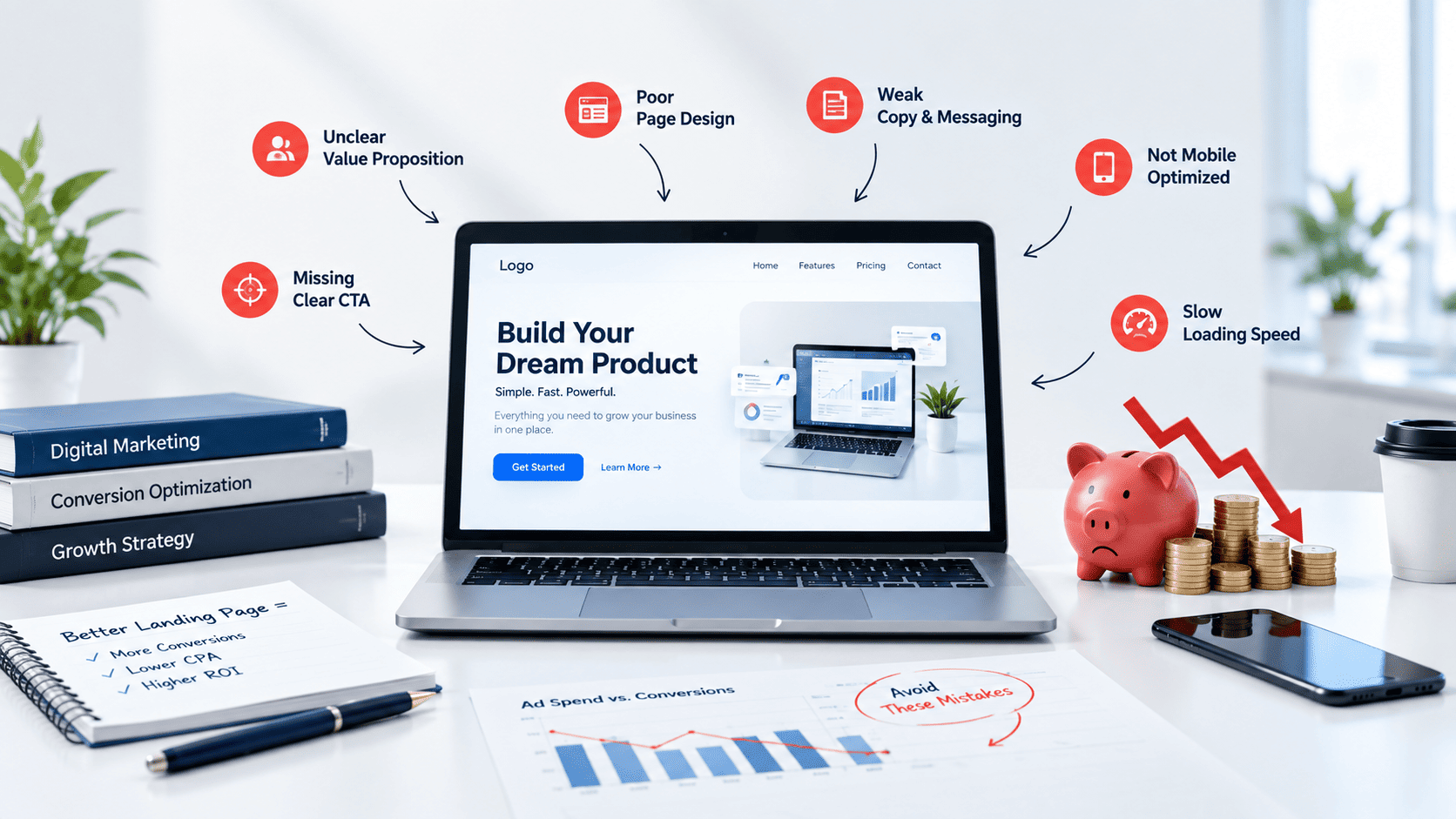
Businesses invest heavily in paid advertising to generate traffic, leads, and sales. Google Ads, Meta Ads, LinkedIn Ads, display campaigns, retargeting, and other paid channels can put a brand directly in front of highly targeted audiences.
But there is a problem that many businesses overlook.
Getting the click does not guarantee the conversion.
A campaign can have strong targeting, compelling creative, competitive click-through rates, and a carefully managed budget while still producing disappointing returns if the landing page fails to convert the visitors it attracts.
Every paid click represents an acquisition cost. If visitors arrive on a landing page and immediately leave because the message is unclear, the page is slow, the offer is weak, the form is complicated, or the experience doesn't match what the advertisement promised, the advertising budget is effectively being spent to create opportunities that the website fails to capture.
This is why landing page optimization and Conversion Rate Optimization (CRO) are critical components of paid acquisition.
A high-performing landing page should make the transition from advertisement to conversion feel natural. The visitor should immediately understand what they are being offered, why it matters, why they should trust the business, and what action they should take next.
The objective isn't simply to make a landing page look better.
It is to extract more value from the traffic you're already paying for.
Whether you're generating leads for an enterprise service, selling ecommerce products, promoting a SaaS platform, or running a campaign for a specific offer, identifying and eliminating landing page mistakes can significantly improve marketing efficiency.
What Is Landing Page Conversion Optimization?
Landing page Conversion Rate Optimization is the process of systematically improving a landing page to increase the percentage of visitors who complete a desired action.
That action could include:
Purchasing a product
Requesting a quote
Booking a consultation
Starting a free trial
Downloading an ebook
Submitting a lead form
Requesting a product demonstration
Scheduling a sales call
Signing up for an event
The fundamental principle is simple:
Don't focus exclusively on generating more traffic. Increase the value generated from the traffic you already have.
Landing Page Mistakes That Are Wasting Your Ad Budget
Many businesses focus heavily on optimizing the advertisement while giving comparatively little attention to the experience after the click.
The following mistakes can quietly reduce the return generated from paid traffic.
1. The Landing Page Doesn't Match the Advertisement
One of the most damaging mistakes is creating a disconnect between the advertisement and the landing page.
Consider an advertisement that says:
"Get a Free Ecommerce Conversion Audit."
The visitor clicks the advertisement expecting information about a conversion audit.
Instead, the landing page headline says:
"Enterprise Digital Commerce Solutions for Growing Brands."
Although the two messages may relate to the same business, they don't immediately satisfy the visitor's original intent.
The visitor now has to search for the offer they were promised.
That creates friction.
A strong paid acquisition journey should maintain message consistency:
Advertisement → Landing Page → Offer → CTA
The visitor should immediately recognize that the landing page delivers what the advertisement promised.
Message consistency can include:
Headline alignment
Offer alignment
Pricing alignment
Visual consistency
Product or service terminology
CTA consistency
The closer the experience matches the visitor's original intent, the easier it becomes for them to continue toward conversion.
2. Sending Paid Traffic to the Homepage
Your homepage is designed to serve many different audiences.
It may contain:
Company information
Multiple products
Several services
Blog content
About information
Navigation menus
Multiple CTAs
Case studies
Careers
Contact information
That makes sense for a homepage.
It doesn't necessarily make sense for a paid campaign.
If an advertisement promotes Shopify Plus development, sending visitors to a generic homepage forces them to determine where they should go next.
A dedicated landing page can remove that decision.
Instead of:
Ad → Homepage → Services → Shopify → Shopify Plus → Contact
the journey can become:
Ad → Shopify Plus Landing Page → CTA
A dedicated landing page gives businesses greater control over the conversion journey and allows the page to be specifically designed around the intent behind the campaign.
3. Using a Generic or Weak Headline
The headline is one of the first things visitors evaluate.
A vague headline can force visitors to spend additional time determining whether the page is relevant.
For example:
"Transform Your Digital Future."
The statement may sound impressive, but it doesn't explain what the visitor receives.
A more specific headline could be:
"Scale Your Shopify Plus Store With Enterprise Ecommerce Development."
The second headline communicates a clearer relationship between the audience, service, and desired outcome.
A strong landing page headline should help answer:
"Am I in the right place?"
Supporting copy can then explain the details.
4. Focusing on Features Instead of Outcomes
Another common mistake is explaining what the product or service does without explaining why the visitor should care.
For example:
"Our platform provides AI-powered analytics and automated reporting."
This explains functionality.
An outcome-focused alternative might be:
"Identify conversion bottlenecks faster and make better decisions with automated ecommerce performance insights."
The second message connects the capability to a business outcome.
Landing pages should therefore communicate:
Problem → Solution → Outcome
Features are important, but visitors generally need to understand how those features help solve their specific problem.
5. Using Too Many Calls-to-Action
A landing page can lose focus when it presents too many competing actions.
For example:
Contact Us
Learn More
Download Guide
Explore Services
Book a Demo
Subscribe
View Case Studies
Start Now
Each additional option introduces another decision.
That doesn't mean secondary CTAs should never exist.
Instead, the page should establish one primary conversion objective.
6. Making Lead Forms Too Long
Long forms can create significant friction. The problem is that the visitor may not yet have enough trust or motivation to provide all of this information.
Ask only for what is necessary at that stage of the customer journey.
For a simple content download, an email address may be sufficient.
For an enterprise consultation, additional qualification fields may be justified.
The principle is:
The information requested should be proportional to the value of the offer.
7. Ignoring Landing Page Speed
A visitor who clicks an advertisement has already demonstrated some level of interest.
The last thing a business should do is make that visitor wait.
Landing page performance can be affected by:
Large images
Excessive JavaScript
Video backgrounds
Third-party tracking scripts
Unoptimized fonts
Poor caching
Heavy animations
Inefficient code
Poor mobile delivery
The problem is particularly important for paid acquisition because every delayed experience represents traffic that has already incurred an acquisition cost.
Landing page performance should therefore be evaluated across the complete journey:
Landing → Interaction → Form/Product → Conversion
The objective isn't simply to make the page technically fast.
It is to make the conversion experience feel fast and effortless.
8. Ignoring Mobile Users
A landing page can perform reasonably well on desktop while delivering a poor experience on mobile.
Mobile visitors interact differently because of:
Smaller screens
Touch interfaces
Virtual keyboards
Mobile networks
Limited visible content
Different browsing behavior
Check whether mobile visitors can easily:
Understand the headline
See the offer
Click the CTA
Read supporting content
Complete forms
View product information
Access trust signals
Complete checkout
Mobile optimization should not simply mean making the desktop page responsive.
The experience should be intentionally designed for smaller screens and touch-based interaction.
9. Not Providing Enough Trust Signals
Paid advertisements frequently introduce visitors to brands they don't know.
That creates uncertainty.
Visitors may ask:
"Can I trust this company?"
"Have other businesses used this service?"
"Is this product legitimate?"
"Is my payment information secure?"
"What happens if something goes wrong?"
Landing pages can reduce this uncertainty through appropriate trust signals, including:
Customer testimonials
Reviews
Case studies
Client logos
Certifications
Security information
Guarantees
Transparent policies
Industry recognition
Results and performance evidence
Instead of simply claiming that a business is trustworthy, show visitors evidence that supports the claim.
10. Offering a Weak Value Proposition
Sometimes the problem isn't the design.
It is the offer.
Compare:
"Contact Us Today."
with:
"Get a Free 30-Minute Ecommerce Conversion Assessment."
The second offer communicates considerably more information.
The visitor understands:
What they receive
How long it takes
What the next step is
Why the interaction could be valuable
A compelling offer reduces the psychological effort required to make a decision.
The landing page should make the value exchange obvious:
What do I receive in return for taking this action?
11. Hiding Important Information
Visitors often leave landing pages because they cannot find answers to questions that influence their decision.
These questions might include:
What does the product or service cost?
What's included?
Who is it designed for?
How long does implementation take?
What happens after submitting the form?
Is there a contract?
Does it integrate with existing technology?
Is the information secure?
What happens after purchase?
Can I cancel or return the product?
The exact questions depend on the audience and offer.
A strong landing page identifies the information gaps that create hesitation and addresses them before the visitor reaches the final conversion decision.
How to Discover Why Paid Visitors Leave Your Landing Page
Fixing conversion problems requires more than making assumptions.
Businesses need to understand what visitors actually do.
Analyze the Conversion Funnel
Break the journey into measurable stages:
Advertisement → Landing Page → Engagement → CTA/Form → Conversion
Then evaluate performance by:
Campaign
Advertisement
Keyword
Audience
Device
Geography
Landing page
Traffic source
This can reveal patterns.
For example, one campaign may generate inexpensive clicks but almost no conversions.
Another may generate fewer clicks but significantly more qualified leads.
The second campaign may actually be more valuable despite having a higher CPC.
Use Heatmaps and Session Recordings
Behavioral analytics can reveal friction that conventional advertising dashboards cannot.
Heatmaps can show:
Where users click
How far they scroll
Which sections receive attention
Which elements are ignored
Where users repeatedly attempt to interact
Session recordings can reveal:
Confusing navigation
Form difficulties
Repeated clicks
Hesitation
Backtracking
Abandonment patterns
These insights help businesses understand the difference between what visitors say and what they actually do.
Collect Customer Feedback
Quantitative data tells you what is happening.
Customer feedback can help explain why.
Businesses can ask:
"What prevented you from completing your purchase?"
"What information were you looking for?"
"Was anything confusing?"
"What almost stopped you from converting?"
These questions can uncover objections and usability problems that analytics alone may not reveal.
Build a Data-Driven Landing Page CRO Process
Landing page optimization should be treated as an ongoing process rather than a one-time redesign.
A practical CRO cycle is:
Analyze → Identify → Prioritize → Test → Measure → Learn → Optimize
For example, suppose analytics shows that many visitors start a lead form but fail to complete it.
Instead of assuming the form design is the problem, create a hypothesis:
Hypothesis: Visitors are abandoning because the form requests unnecessary information.
Test:
Reduce the form from 10 fields to 5 essential fields.
Then measure:
Form starts
Form completion
Conversion rate
Cost per conversion
Lead quality
The objective is not to win an argument about design.
It is to determine which experience produces the best business outcome.
Landing Page Metrics That Matter
Advertising Metrics
Monitor:
Impressions
Click-through rate
Cost per click
Paid sessions
Cost per acquisition
These metrics help evaluate the efficiency of traffic acquisition.
Engagement Metrics
Monitor:
Landing page engagement
Scroll depth
CTA interactions
Form starts
Form completion
Product interactions
These metrics help determine whether visitors are engaging with the page.
Conversion Metrics
Track:
Conversion rate
Lead conversion rate
Purchase conversion rate
Cost per conversion
Qualified lead rate
These metrics connect landing page performance to actual conversion outcomes.
Revenue Metrics
For ecommerce and revenue-focused campaigns, monitor:
Revenue per visitor
Average Order Value
Customer Acquisition Cost
Customer Lifetime Value
Return on Ad Spend
These metrics provide a more complete picture of advertising efficiency.
Business Outcome Metrics
Ultimately, businesses should evaluate:
Qualified opportunities
Sales conversion rate
Revenue generated
Customer retention
Customer lifetime value
Marketing efficiency
A landing page that generates fewer leads but substantially more qualified customers may outperform one generating large quantities of low-quality leads.
Landing Page Mistakes to Avoid Before Increasing Ad Spend
Before increasing an advertising budget, businesses should evaluate whether the current landing page can effectively handle additional traffic.
Ask:
Does the page match the advertisement?
Is the value proposition immediately clear?
Is the offer compelling?
Is the CTA obvious?
Is the page fast?
Does it work well on mobile?
Does the page provide enough trust?
Are the forms unnecessarily complicated?
Are customer objections addressed?
Can visitors easily understand what happens next?
If the answer to several of these questions is no, increasing advertising spend may simply increase the amount of traffic entering an inefficient conversion funnel.
The smarter approach is often to improve the experience first.
How Radianzz Helps Businesses Improve Landing Page Conversions
At Radianzz, we approach landing page optimization as a combination of strategy, UX, technology, performance, analytics, and continuous experimentation.
The goal isn't simply to create visually attractive pages.
The objective is to build landing experiences that help businesses generate greater value from their existing paid traffic.
Landing Page Strategy & CRO Consulting
Every optimization initiative starts by understanding:
Campaign objectives
Target audiences
Search and advertising intent
Offers
Conversion objectives
Existing performance
Customer objections
This creates a strategic foundation for landing page improvements.
UX & Conversion Optimization
We analyze conversion friction across:
Headlines
Content
CTAs
Forms
Navigation
Mobile experiences
Trust signals
Conversion flows
The objective is to create a journey that is easier for visitors to understand and complete.
Performance Optimization
Landing page performance can influence both user experience and marketing efficiency.
Our teams can optimize:
Page loading
Images
JavaScript
Third-party scripts
Mobile experiences
Caching
Frontend implementation
Analytics & Experimentation
Effective CRO requires continuous measurement.
We use approaches including:
Funnel analysis
Heatmaps
Session recordings
Customer feedback
Conversion analysis
A/B testing
Performance monitoring
This allows optimization decisions to be based on observed customer behavior rather than assumptions.
Conclusion
Paid advertising creates the opportunity to acquire a customer.
The landing page determines how effectively that opportunity is converted.
Businesses can spend thousands of dollars generating highly targeted traffic, but if visitors encounter unclear messaging, slow performance, weak CTAs, complicated forms, poor mobile experiences, or insufficient trust, much of that investment can fail to produce its intended business outcome.
Before increasing your advertising budget, examine the experience receiving that traffic.
Ask whether the landing page:
Matches the advertisement
Communicates the offer immediately
Focuses on customer outcomes
Builds trust
Removes objections
Makes the CTA obvious
Minimizes unnecessary friction
Works exceptionally well on mobile
Loads quickly
Provides a simple path to conversion
Most importantly, measure what happens after the click.
Because sometimes the problem isn't your advertising campaign.
Your campaign may be generating exactly the traffic you paid for.
Your landing page may be wasting the opportunity.