

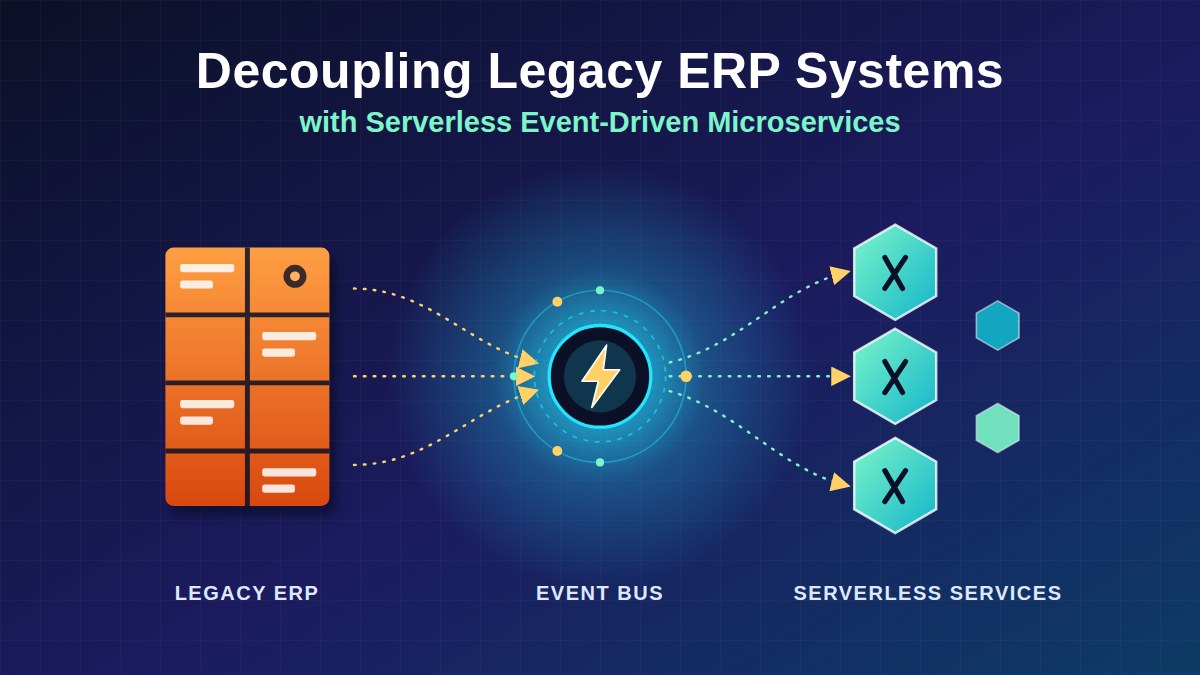
Enterprise ERP systems are often at the center of critical business operations.
They manage processes such as:
Orders
Inventory
Procurement
Finance
Customer records
Pricing
Fulfillment
Supplier management
Product information
Warehouse operations
For many organizations, these systems have evolved over years or even decades.
The problem is that the ERP may have become tightly connected to almost every other enterprise application.
An ecommerce platform communicates directly with the ERP.
The CRM depends on ERP data.
The warehouse management system exchanges information with the ERP.
Reporting platforms extract data from ERP databases.
Custom applications depend on proprietary ERP interfaces.
As the number of dependencies increases, the ERP becomes more than a business application.
It becomes an architectural bottleneck.
Replacing such a system is expensive, disruptive, and risky.
But continuing to build directly around it creates another problem: every new digital capability becomes increasingly dependent on legacy architecture.
This is where serverless event-driven microservices can provide an alternative modernization strategy.
Instead of replacing the ERP immediately, enterprises can gradually decouple business capabilities from it.
Why Legacy ERP Systems Become Integration Bottlenecks
Legacy ERP platforms were often designed for centralized processing.
A typical architecture might look like:
Ecommerce Platform → ERP Application → ERP Database
Additional systems then connect directly to the same environment:
CRM → ERP
WMS → ERP
Analytics → ERP
Customer Portal → ERP
Supplier Portal → ERP
As these connections multiply, the ERP becomes responsible for an increasing number of requests.
This creates several challenges.
Tight Coupling
Applications become dependent on ERP-specific APIs, database structures, business rules, or proprietary interfaces.
Changing one component can therefore affect multiple downstream systems.
Synchronous Dependencies
A modern application may need to wait for the ERP to respond before completing an operation.
If the ERP is slow or unavailable, dependent applications may also experience delays.
Scaling Constraints
The ERP may be capable of handling normal transaction volumes but struggle when external systems generate sudden traffic spikes.
For example, an ecommerce flash sale could generate thousands of order and inventory requests within minutes.
Release Dependencies
When several applications depend on the same ERP interfaces, even relatively small changes can require extensive integration testing.
This slows innovation.
Difficult Modernization
Enterprises increasingly want to adopt:
AI applications
Real-time analytics
Headless commerce
Mobile applications
Customer self-service
IoT
Automated workflows
But tightly coupled ERP architectures make these initiatives more difficult to implement.
What Does ERP Decoupling Mean?
ERP decoupling means reducing direct dependencies between the ERP and surrounding applications.
Instead of every system communicating directly with the ERP, an integration layer can expose business capabilities through APIs and events.
A simplified architecture becomes:
Application → API / Event Layer → Microservice → ERP
Or:
ERP → Event Broker → Microservices → Applications
The ERP remains operational, but other applications no longer need to understand every internal detail of the ERP.
This creates an abstraction layer between the legacy system and modern applications.
How Event-Driven Architecture Changes ERP Integration
Traditional integration frequently relies on synchronous requests.
For example:
Ecommerce → ERP API → Response → Ecommerce
With an event-driven architecture, the workflow can instead become:
Order Created → Event Published → Consumers Process Event
Multiple systems can consume the same event.
For example:
Order Created
↓
Event Broker
↓
Inventory Service
Fulfillment Service
Analytics Service
Customer Notification Service
ERP Integration Service
This approach reduces the need for every system to communicate directly with every other system.
The Role of Serverless Microservices
Serverless functions can execute specific business or integration tasks without requiring enterprises to operate traditional application servers for each workload.
Examples include:
AWS Lambda
Azure Functions
Google Cloud Functions
A serverless function could:
Receive an order event.
Validate the event.
Transform the data.
Call the ERP API.
Publish the result.
Record execution status.
Instead of maintaining a permanently running integration application, the function executes when required.
This can be particularly valuable for event-driven workloads with variable traffic.
Core Architecture for Decoupling a Legacy ERP
A modernized architecture could include several layers.
API Gateway
An API gateway provides controlled access to backend services.
It can handle:
Authentication
Authorization
Routing
Rate limiting
Request transformation
Monitoring
Applications therefore interact with standardized APIs rather than directly accessing ERP interfaces.
Event Broker
The event broker distributes business events to appropriate consumers.
Examples include:
Amazon EventBridge
Apache Kafka
Azure Event Grid
Google Pub/Sub
The broker becomes the communication backbone for asynchronous workflows.
Serverless Functions
Functions perform focused operations.
For example:
Order Event → Lambda → ERP Order API
Another function could process:
Inventory Updated → Lambda → Ecommerce Inventory API
Message Queues
Queues provide buffering between systems.
This is particularly useful when the ERP cannot process requests as quickly as modern applications generate them.
Instead of overwhelming the ERP, messages can wait in the queue until the ERP integration service is ready.
Using the Strangler Pattern for ERP Modernization
One of the biggest risks of ERP modernization is attempting to replace everything simultaneously.
The Strangler Pattern provides a more gradual alternative.
The concept is simple:
Instead of replacing the ERP in one project, enterprises gradually move individual capabilities into modern services.
For example:
Phase 1
ERP handles:
Orders
Inventory
Pricing
Customers
Fulfillment
Phase 2
A new inventory service is introduced.
Phase 3
A new pricing service is introduced.
Phase 4
A modern order orchestration service is introduced.
Over time, fewer capabilities remain dependent on the legacy ERP.
This approach allows organizations to modernize progressively rather than taking on a massive replacement project.
Example: Decoupling Ecommerce from a Legacy ERP
Consider an enterprise retailer using a legacy ERP for inventory and order processing.
A traditional architecture might look like:
Shopify / Ecommerce Platform → ERP → Database
Every order creates an immediate ERP request.
During a major sales campaign, thousands of requests may arrive simultaneously.
A decoupled architecture could instead use:
Shopify → Order Event → Event Broker
The event broker distributes the event to multiple services.
Order Service
Processes the order.
Inventory Service
Updates inventory availability.
ERP Integration Service
Synchronizes required information with the legacy ERP.
Analytics Service
Sends order information to the analytics platform.
Notification Service
Triggers customer communications.
The ERP becomes one participant in the ecosystem rather than the central dependency for every process.
Managing Eventual Consistency
Decoupling introduces an important architectural consideration:
Data may not update everywhere simultaneously.
This is known as eventual consistency.
For example:
A customer places an order.
The ecommerce platform records it immediately.
The ERP receives the event a few seconds later.
The analytics platform may receive it independently.
This is different from a traditional synchronous transaction.
Businesses therefore need to determine which operations require immediate consistency and which can tolerate asynchronous synchronization.
Handling Failed Events and Retries
Event-driven systems must assume that failures will occur.
A message may fail because:
ERP API is unavailable
Network connectivity fails
Authentication expires
ERP rejects the request
Payload validation fails
Serverless function times out
A robust architecture should therefore include:
Retry mechanisms
Dead-letter queues
Error handling
Idempotency
Monitoring
Alerting
Replay capabilities
Why Idempotency Matters
An event could potentially be delivered more than once.
If an order-processing function isn't idempotent, the same event could accidentally create duplicate transactions.
The system should therefore recognize previously processed events and prevent duplicate operations.
Protecting the Legacy ERP During Traffic Spikes
One of the most valuable benefits of decoupling is protecting the ERP from unpredictable workloads.
Instead of allowing every external application to directly call ERP APIs, a queue can absorb bursts.
For example:
10,000 ecommerce events
↓
Message Queue
↓
Controlled ERP Processing
The queue acts as a buffer.
This allows the surrounding digital ecosystem to scale independently while ERP processing remains controlled.
Observability Becomes Essential
Distributed systems create new visibility challenges.
When a transaction crosses multiple services, engineers need to understand where something failed.
A production architecture should monitor:
Event throughput
Function execution
API latency
Queue depth
Failed events
Retry volume
ERP response times
Processing latency
Duplicate events
Dead-letter queues
Distributed tracing can help connect individual operations across multiple services.
For example:
Order ID → Ecommerce → Event Broker → Function → ERP → Fulfillment
This makes troubleshooting significantly easier.
Security Considerations for ERP Decoupling
ERP systems contain highly sensitive enterprise information.
Modern integration architectures should therefore implement strong security controls.
These may include:
API authentication
Role-based access control
Encryption
Secrets management
Network segmentation
Least-privilege permissions
Audit logging
Token-based authentication
Serverless does not automatically make an architecture secure.
Security must be designed into every integration layer.
Common Mistakes When Decoupling Legacy ERP Systems
Attempting a Big-Bang Replacement
Replacing the entire ERP and all integrations simultaneously creates unnecessary risk.
Incremental modernization is often easier to control.
Creating Too Many Microservices
Microservices should represent meaningful business capabilities.
Creating hundreds of tiny services can introduce unnecessary operational complexity.
Ignoring Data Ownership
Every service should have a clear understanding of which system owns specific business data.
Building Synchronous Dependencies Everywhere
Simply placing APIs in front of legacy systems does not create true decoupling.
Asynchronous events should be used where business processes allow them.
Ignoring Failure Scenarios
Distributed systems must be designed around failure.
Retries, dead-letter queues, idempotency, and monitoring should be part of the architecture from the beginning.
How Radianzz Helps Modernize Legacy ERP Architectures
Modernizing an enterprise ERP ecosystem requires more than moving workloads to the cloud.
At Radianzz, we help businesses evaluate legacy architectures and identify opportunities to introduce modern integration patterns without unnecessarily disrupting mission-critical operations.
ERP Modernization Strategy
We assess existing:
ERP dependencies
APIs
Data flows
Integration points
Business processes
Application dependencies
The objective is to identify where decoupling can create the greatest business value.
Event-Driven Architecture
We design event-driven architectures that allow systems to communicate through business events rather than unnecessary point-to-point dependencies.
Serverless Integration
Serverless functions can be introduced for targeted integration workloads, enabling elastic processing without requiring dedicated infrastructure for every service.
API & Microservices Architecture
We help establish service boundaries around meaningful business capabilities while creating standardized APIs between modern applications and legacy systems.
Incremental ERP Modernization
Rather than forcing organizations into immediate ERP replacement, modernization can be approached incrementally.
This reduces operational risk while creating a path toward a more flexible enterprise architecture.
Measuring the Success of ERP Decoupling
A modernization project should be evaluated using measurable business and technical outcomes.
Important metrics include:
System Performance
API response time
Event processing latency
ERP transaction throughput
Reliability
Failed transaction rate
Event processing success rate
System availability
Scalability
Peak event throughput
Queue processing capacity
Function concurrency
Operational Efficiency
Integration maintenance effort
Deployment frequency
Incident resolution time
Business Impact
Faster feature launches
Reduced operational disruption
Improved ecommerce scalability
Reduced ERP dependency
Improved customer experience
Conclusion
Legacy ERP systems don't necessarily need to disappear before enterprises can modernize.
The greater opportunity may be to change how the rest of the enterprise interacts with them.
By introducing serverless functions, event brokers, APIs, queues, and domain-focused microservices, organizations can progressively reduce direct dependencies on legacy ERP infrastructure.
The result is an architecture where the ERP remains responsible for the capabilities it handles well, while modern services provide the flexibility required for ecommerce, analytics, customer experiences, automation, and digital innovation.
The most effective modernization strategy is therefore not always:
Replace the ERP.
It can instead be:
Decouple → Modernize → Scale → Gradually Replace Where Necessary.
For enterprises operating mission-critical legacy ERP environments, this incremental approach can provide a practical path toward a more scalable, resilient, and adaptable technology ecosystem without exposing the business to the unnecessary risk of a big-bang transformation.