
Selecting an ecommerce platform has never been more complex or more important.
Today's digital commerce landscape extends far beyond launching an online store. Businesses are expected to deliver seamless shopping experiences across websites, mobile applications, marketplaces, social commerce, and physical retail locations. Customers expect personalized recommendations, lightning-fast page speeds, secure transactions, flexible payment options, and consistent experiences regardless of where they interact with a brand.
At the same time, organizations face mounting pressure to innovate quickly. Marketing teams need the freedom to launch campaigns without lengthy development cycles. IT leaders require scalable, secure infrastructure that integrates with existing business systems. Operations teams need streamlined workflows, while executives expect technology investments to support long-term growth rather than create future limitations.
Against this backdrop, choosing the right ecommerce platform becomes a strategic business decision not just a technical one.
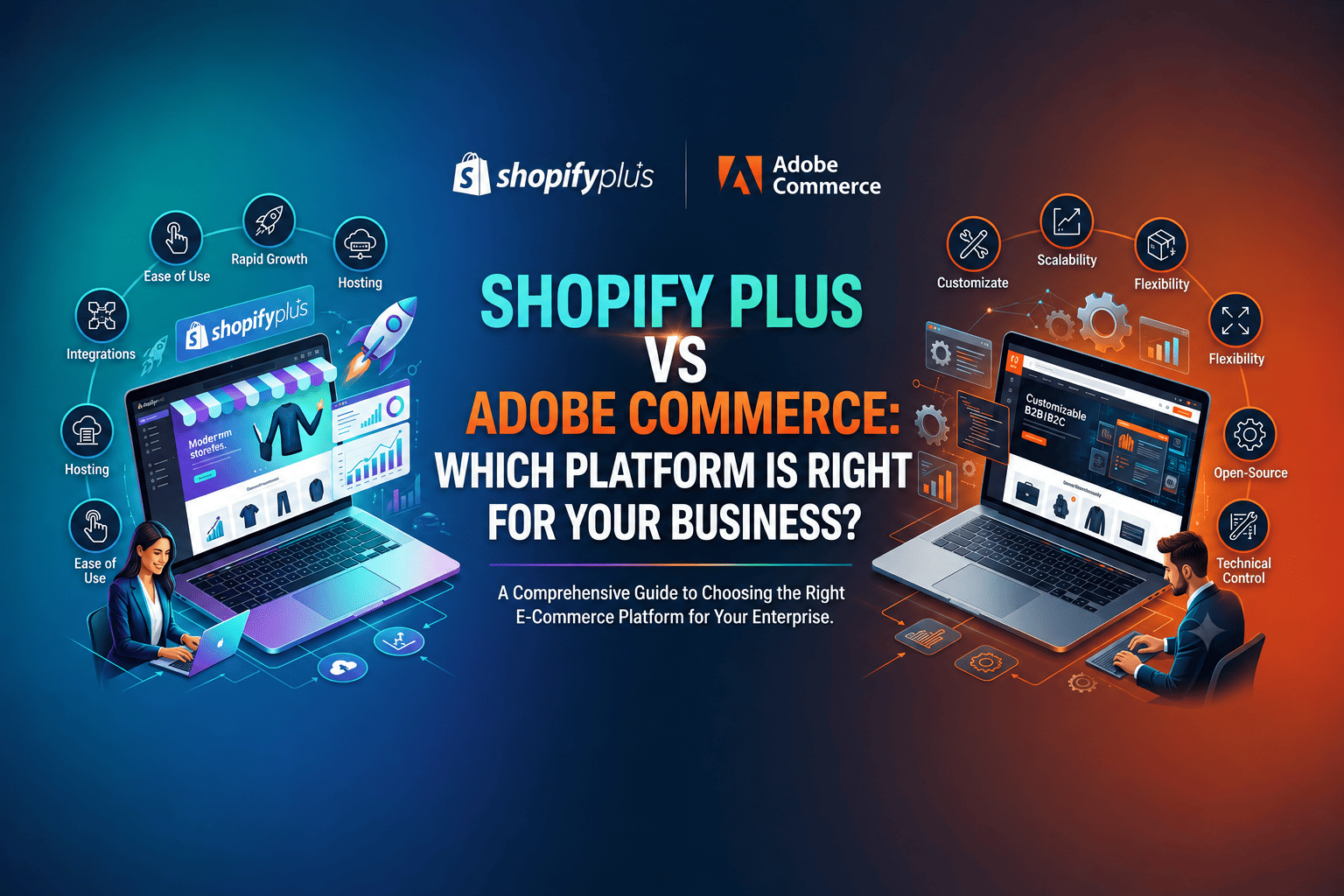
Among enterprise commerce platforms, Shopify Plus and Adobe Commerce consistently emerge as two of the most recognized options. Both power global brands and offer robust capabilities, yet they are built on fundamentally different philosophies.
Shopify Plus prioritizes simplicity, speed, and a managed cloud experience. It enables businesses to launch and scale quickly while minimizing infrastructure complexity.
Adobe Commerce, formerly known as Magento Commerce, emphasizes flexibility, deep customization, and enterprise-grade functionality. It offers extensive control over nearly every aspect of the commerce experience, making it a compelling choice for organizations with highly specific requirements.
Neither platform is universally better.
The right choice depends on your business model, operational complexity, technical resources, growth ambitions, and customer experience strategy.
This comprehensive guide compares Shopify Plus and Adobe Commerce across architecture, customization, scalability, performance, SEO, security, integrations, pricing, and long-term value. By the end, you'll have a clear framework to determine which platform aligns best with your organization's current needs and future goals.
Understanding Shopify Plus
Shopify Plus is the enterprise edition of Shopify, designed for high-growth brands and large-scale retailers seeking a reliable, cloud-based commerce platform.
Unlike self-hosted solutions, Shopify Plus operates as a fully managed Software-as-a-Service (SaaS) platform. This means Shopify handles hosting, security, updates, infrastructure, and performance optimization, allowing businesses to focus on growth rather than platform maintenance.
One of Shopify Plus's greatest strengths is its simplicity. Organizations can deploy storefronts more quickly, onboard teams with minimal training, and reduce the operational burden typically associated with managing enterprise ecommerce infrastructure.
Key capabilities include:
Unlimited staff accounts
Global storefront management
Multi-currency and multilingual support
Shopify Flow for workflow automation
Shopify Functions for checkout customization
Extensive app ecosystem
Built-in security and compliance
Headless commerce support via Hydrogen and Oxygen
Shopify Plus is particularly well-suited for direct-to-consumer (DTC) brands, fast-growing retailers, subscription businesses, and organizations that value speed, reliability, and ease of management.
Understanding Adobe Commerce
Adobe Commerce is an enterprise-grade ecommerce platform built for organizations requiring extensive customization, sophisticated business logic, and deep integration capabilities.
Originally introduced as Magento before becoming part of Adobe's Experience Cloud, Adobe Commerce has long been recognized for its flexibility and developer-centric architecture.
Unlike Shopify Plus, Adobe Commerce provides businesses with greater control over both the frontend and backend of their ecommerce environment. Organizations can tailor virtually every aspect of the platform to support unique operational requirements.
Adobe Commerce excels in environments where businesses need:
Complex product catalogs
Advanced B2B functionality
Custom pricing structures
Multi-store management
Deep ERP and CRM integrations
Highly customized checkout experiences
Extensive workflow automation
This flexibility comes with increased responsibility. Adobe Commerce implementations often require dedicated development teams, ongoing maintenance, infrastructure management (depending on deployment), and a higher level of technical expertise.
For enterprises with complex operational requirements, however, that investment can provide significant long-term value.
Shopify Plus vs Adobe Commerce: At a Glance
Before exploring individual capabilities, it's helpful to compare both platforms at a high level.
Feature | Shopify Plus | Adobe Commerce |
Deployment | SaaS | Cloud / Self-Hosted |
Ease of Use | Excellent | Moderate to Complex |
Customization | High | Very High |
Infrastructure Management | Shopify Managed | Business Managed / Adobe Managed |
Development Requirements | Low to Moderate | High |
B2B Features | Strong | Excellent |
Headless Commerce | Supported | Supported |
Security | Built-in | Configurable |
Upgrade Complexity | Minimal | Moderate |
Time to Launch | Faster | Longer |
Architecture Comparison
The architectural differences between Shopify Plus and Adobe Commerce influence everything from scalability to maintenance, customization, and operational costs.
Shopify Plus Architecture
Shopify Plus follows a SaaS architecture where infrastructure, hosting, security updates, and platform maintenance are managed by Shopify.
This model reduces operational overhead and ensures consistent performance without requiring internal infrastructure teams.
Businesses benefit from:
Automatic updates
High availability
Managed hosting
PCI compliance
Built-in scalability
Simplified DevOps
For organizations focused on speed to market, this architecture minimizes complexity and accelerates deployment.
Adobe Commerce Architecture
Adobe Commerce offers significantly greater architectural flexibility.
Organizations can deploy Adobe Commerce in cloud environments or self-hosted configurations, depending on their business requirements.
This flexibility allows businesses to:
Build custom workflows
Develop unique commerce experiences
Integrate specialized enterprise systems
Customize backend logic
Control infrastructure decisions
While this level of control is advantageous for complex enterprises, it also introduces greater responsibility for platform management, updates, performance tuning, and ongoing maintenance.
Ease of Use and Administration
One of the most significant differences between Shopify Plus and Adobe Commerce lies in day-to-day platform management.
Shopify Plus is designed for business users. Marketing teams, merchandisers, and content managers can perform many routine tasks independently through an intuitive interface, reducing reliance on developers for everyday operations.
Adobe Commerce, while powerful, typically requires a higher level of technical expertise. Content updates, feature enhancements, and workflow modifications often involve development resources, particularly in heavily customized implementations.
For organizations with limited in-house technical teams, Shopify Plus generally offers a lower operational burden.
For enterprises with dedicated development resources and highly specialized requirements, Adobe Commerce provides greater flexibility and control.
Customization and Extensibility
Every ecommerce business has unique operational requirements. As organizations grow, they often need to introduce custom workflows, integrate specialized applications, and deliver tailored customer experiences. This is where customization becomes a critical consideration when choosing an enterprise ecommerce platform.
Although both Shopify Plus and Adobe Commerce support customization, they approach it differently.
Shopify Plus
Shopify Plus is built around a structured framework that balances flexibility with platform stability. Businesses can customize storefronts, extend functionality through APIs, leverage Shopify Functions for business logic, and use a vast ecosystem of applications to add new capabilities.
The platform also supports headless commerce, allowing organizations to create highly customized frontend experiences while maintaining Shopify as the commerce engine.
This approach enables businesses to innovate rapidly without increasing maintenance complexity.
Best suited for:
Fast-growing ecommerce businesses
Direct-to-consumer (DTC) brands
Multi-store retailers
Organizations prioritizing speed and operational simplicity
Adobe Commerce
Adobe Commerce offers virtually unlimited customization capabilities.
Businesses can modify nearly every aspect of the platform, from product management and checkout workflows to pricing rules, order processing, and backend operations. This level of flexibility makes Adobe Commerce well suited for organizations with highly specialized requirements.
The trade-off is that extensive customization often requires experienced development teams and ongoing maintenance.
Best suited for:
Large enterprises
Businesses with complex operational workflows
Organizations requiring extensive system customization
Companies with dedicated in-house development resources
SEO Capabilities
Organic search remains one of the most valuable acquisition channels for ecommerce businesses. The platform you choose can significantly influence technical SEO, site performance, and content management capabilities.
Shopify Plus SEO
Shopify Plus provides a strong technical SEO foundation with features such as:
Automatic XML sitemaps
SSL security
Mobile-responsive themes
Built-in canonical tags
Structured data support
Fast page loading through its global infrastructure
Automatic image optimization (theme dependent)
Its managed architecture helps maintain consistent performance and Core Web Vitals, reducing the technical overhead associated with SEO maintenance.
Shopify Plus also integrates seamlessly with leading SEO tools, analytics platforms, and marketing applications, enabling businesses to optimize content and monitor performance effectively.
Adobe Commerce SEO
Adobe Commerce provides greater control over technical SEO implementation.
Businesses can customize:
URL structures
Metadata
Canonical tags
Robots directives
XML sitemaps
Structured data
Internal linking strategies
This flexibility is valuable for organizations with advanced SEO requirements. However, achieving optimal performance often depends on proper implementation, infrastructure optimization, and ongoing maintenance.
Without careful configuration, customizations can introduce performance or crawlability issues.
Expert Recommendation
From an SEO perspective, neither platform is inherently superior.
Shopify Plus is ideal for businesses seeking a fast, secure, and low-maintenance SEO foundation.
Adobe Commerce is better suited to organizations with advanced SEO strategies and the technical expertise to manage them effectively.
The best results ultimately depend on content quality, site architecture, page performance, and a consistent optimization strategy.
Performance and Scalability
As ecommerce businesses grow, performance and scalability become increasingly important. Slow-loading websites, infrastructure limitations, and downtime during peak traffic can directly affect customer experience and revenue.
Shopify Plus Performance
Shopify Plus is built on a globally distributed cloud infrastructure designed to handle high traffic volumes without requiring businesses to manage servers or hosting environments.
Key advantages include:
Automatic scaling during traffic spikes
High platform availability
Built-in CDN support
Optimized checkout performance
Continuous infrastructure improvements managed by Shopify
This architecture enables businesses to focus on growth rather than infrastructure management.
Adobe Commerce Performance
Adobe Commerce offers significant flexibility in performance optimization.
Organizations can tailor infrastructure, caching strategies, database configurations, and hosting environments to meet specific business needs.
When properly configured, Adobe Commerce can deliver excellent performance for large, complex ecommerce operations.
However, achieving consistent performance requires experienced technical teams and ongoing optimization efforts.
Businesses are responsible for monitoring infrastructure, applying updates, and ensuring the platform remains optimized as traffic and functionality grow.
Performance Comparison
Capability | Shopify Plus | Adobe Commerce |
Infrastructure Management | Fully Managed | Business Managed / Cloud Managed |
Automatic Scaling | ✔ | Configuration Dependent |
CDN Included | ✔ | Depends on Hosting |
Performance Optimization | Built-in | Requires Configuration |
Peak Traffic Handling | Excellent | Excellent (with optimization) |
Operational Complexity | Low | Moderate to High |
Security and Compliance
Security is a fundamental requirement for enterprise ecommerce, especially when handling customer information, online payments, and sensitive business data.
Shopify Plus Security
Shopify Plus provides enterprise-grade security as part of its managed platform.
Businesses benefit from:
PCI DSS compliance
SSL certificates
Continuous security monitoring
Automatic platform updates
Built-in fraud analysis tools
Secure payment infrastructure
Since Shopify manages the underlying platform, businesses spend less time addressing infrastructure-level security concerns.
Adobe Commerce Security
Adobe Commerce provides comprehensive security capabilities but places greater responsibility on the organization implementing the platform.
Security typically includes:
Security patches
Access controls
Data encryption
Authentication management
Role-based permissions
Compliance support
Organizations using Adobe Commerce must ensure updates, monitoring, infrastructure security, and ongoing maintenance are performed consistently.
This provides greater flexibility but also increases operational responsibility.
Integration Capabilities
Modern ecommerce platforms rarely operate in isolation. They need to integrate seamlessly with ERP systems, CRM platforms, payment gateways, marketing automation tools, customer support applications, and analytics platforms.
Shopify Plus
Shopify Plus supports thousands of integrations through its App Store and API ecosystem.
Common integrations include:
ERP platforms
CRM systems
Email marketing platforms
Inventory management systems
Payment gateways
Shipping providers
Analytics tools
Customer support platforms
Its API-first approach makes it easier to extend functionality while maintaining platform stability.
Adobe Commerce
Adobe Commerce is equally capable of integrating with enterprise technology ecosystems.
Its open architecture enables businesses to build highly customized integrations with:
ERP solutions
Product Information Management (PIM) systems
Customer Data Platforms (CDP)
Marketing automation platforms
Warehouse Management Systems (WMS)
Business intelligence platforms
Custom enterprise applications
Organizations with complex integration requirements often appreciate the flexibility Adobe Commerce provides.
Which Platform Is Better for Growing Businesses?
The answer depends less on the size of the business and more on its operational priorities.
Businesses focused on launching quickly, reducing maintenance overhead, and enabling marketing teams to move faster often find Shopify Plus aligns well with their objectives.
Organizations with highly specialized workflows, extensive customization needs, or complex enterprise ecosystems may find Adobe Commerce offers greater long-term flexibility.
Rather than asking which platform is "better," businesses should evaluate which platform better supports their strategy, operational model, and customer experience goals.
How Radianzz Helps Businesses Choose the Right Commerce Platform
Selecting an enterprise ecommerce platform is a strategic business decision that extends beyond technology. The right platform should support your growth plans, operational workflows, customer experience objectives, and long-term digital strategy.
At Radianzz, we help organizations evaluate, implement, and optimize ecommerce ecosystems that align with both current business needs and future scalability.
Our expertise includes:
Ecommerce Strategy & Consulting
We assess your existing commerce ecosystem, identify operational challenges, and recommend the platform that best aligns with your business objectives.
Shopify Plus Development
From storefront implementation to custom functionality and integrations, we help businesses maximize the value of Shopify Plus while ensuring performance, scalability, and a seamless customer experience.
Adobe Commerce Development
Our team designs and develops customized Adobe Commerce solutions tailored to complex business requirements, enabling organizations to build scalable and highly flexible commerce ecosystems.
Headless Commerce Solutions
We build modern commerce experiences using API-first architectures that separate the frontend from backend systems, providing greater agility and flexibility.
Systems Integration
We connect ecommerce platforms with ERP, CRM, PIM, payment gateways, marketing automation platforms, and other business-critical systems to create a unified digital ecosystem.
UI/UX Design
Our design team creates intuitive, customer-centric shopping experiences focused on improving engagement, usability, and conversion.
Performance Optimization
We continuously optimize ecommerce platforms for speed, scalability, accessibility, and user experience to help businesses meet evolving customer expectations.
Conclusion
Selecting an enterprise ecommerce platform is far more than a technology decision—it's a strategic investment that can shape how your business grows, innovates, and serves customers over the coming years.
Both Shopify Plus and Adobe Commerce are powerful platforms trusted by leading brands worldwide, yet they solve different business challenges.
Shopify Plus stands out for organizations that value speed, simplicity, operational efficiency, and a fully managed cloud experience. Its intuitive administration, robust ecosystem, and reliable infrastructure make it an attractive choice for businesses looking to scale quickly while minimizing technical overhead.
Adobe Commerce, on the other hand, offers unmatched flexibility for organizations with complex operational requirements, sophisticated integrations, and highly customized customer experiences. For businesses with dedicated technical teams and specialized commerce needs, it provides the freedom to build tailored digital ecosystems.