

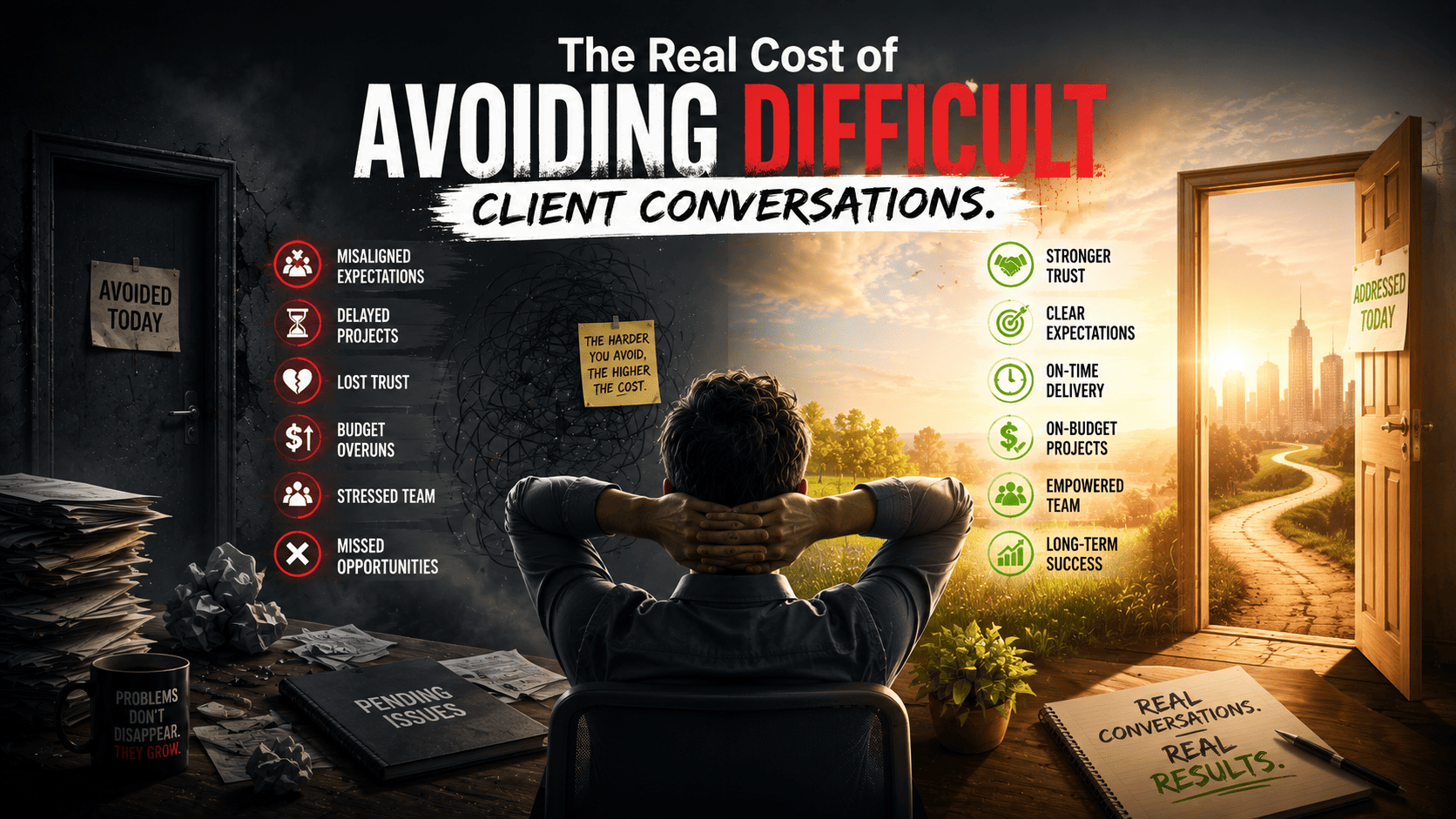
Strong client relationships are rarely undone by a single incident. More often, they weaken gradually—through delayed updates, unresolved concerns, shifting expectations, and conversations that never happen when they should.
Across consulting firms, digital agencies, software providers, and enterprise service organizations, the instinct to postpone uncomfortable discussions is surprisingly common. Teams convince themselves that waiting is the responsible choice. They hope an issue can be resolved before the client notices, or that additional time will produce a better answer. In the moment, that decision can feel thoughtful and measured.
Unfortunately, time rarely improves a communication problem.
When information is withheld—even with good intentions—clients are left to interpret silence on their own. Questions replace certainty. Confidence begins to erode. By the time the conversation finally takes place, the challenge itself is often no longer the biggest concern. The real issue becomes why the client learned about it so late.
Experienced business leaders understand an important distinction: clients do not expect flawless execution from every project. They do expect honesty, visibility, and confidence that they will never be left in the dark when circumstances change.
Projects evolve. Priorities shift. Technical obstacles emerge. Budgets are revisited. None of these situations automatically damage a relationship. Poor communication, however, often does.
Organizations that consistently retain clients over many years tend to share one characteristic. They communicate early, explain situations openly, and invite clients into the decision-making process before uncertainty grows into frustration.
Handled well, a difficult conversation becomes more than a project update. It demonstrates accountability, reinforces trust, and proves that the relationship is built on partnership rather than convenience.
This article examines why difficult client conversations are so often postponed, the hidden business costs that follow, and how transparent communication becomes a competitive advantage that extends well beyond any single engagement.
Why Difficult Conversations Feel So Difficult
Most professionals recognize the moment immediately.
A milestone slips.
A dependency changes.
The original estimate no longer reflects reality.
Additional work appears outside the agreed scope.
The next conversation is obvious.
Scheduling it is not.
Even experienced account managers, consultants, and business leaders hesitate. The hesitation rarely comes from a lack of professionalism. Instead, it reflects a natural desire to preserve momentum and avoid creating unnecessary concern.
Conflict, especially with valued clients, carries emotional weight. Nobody enjoys delivering disappointing news or introducing uncertainty into a relationship that has been progressing well.
The challenge is that delaying the discussion often increases the very tension we hope to avoid.
Small concerns become larger ones simply because they remain unspoken.
The Psychology Behind Avoidance
Avoidance is often driven by optimism rather than negligence.
Leaders tell themselves that another day or two will provide a complete solution. Teams believe they can recover lost progress without involving the client. Managers assume there is little value in raising a concern before every answer has been identified.
These thoughts are understandable because they stem from a genuine desire to protect the client experience.
Typical internal reasoning sounds familiar:
"Let's confirm the root cause before we say anything."
"There's still a chance we'll recover the timeline."
"The client already has enough on their plate."
"We'll provide one comprehensive update instead of several partial ones."
"There's no reason to create concern if we can solve it ourselves."
The problem is not the intention behind these decisions.
It is the delay they create.
By the time certainty finally arrives, clients often wonder why the issue remained invisible for so long. What could have been a collaborative discussion about solutions becomes a conversation about transparency and confidence.
The Hidden Business Cost of Silence
Communication gaps rarely produce immediate consequences.
That is precisely what makes them dangerous.
Missing one update may appear insignificant. Postponing a difficult phone call by a few days can feel harmless. Yet every delay quietly changes the way clients interpret the relationship.
When visibility decreases, people naturally begin filling in the blanks with their own assumptions. Those assumptions are rarely generous because uncertainty encourages caution rather than confidence.
This creates a chain reaction.
Questions become skepticism.
Skepticism becomes hesitation.
Hesitation gradually reshapes the entire client experience.
Eventually, routine discussions around timelines, invoices, recommendations, or project direction become more challenging—not because the work has deteriorated, but because confidence has.
In many engagements, the communication gap costs considerably more than the original issue itself.
Trust Is Earned Most During Difficult Moments
Successful projects certainly strengthen relationships.
Challenging moments reveal the strength of those relationships.
Imagine two organizations facing the exact same delivery delay.
The first informs its client immediately, explains the contributing factors, outlines available options, adjusts expectations collaboratively, and provides a clear recovery strategy.
Although the schedule changes, the client remains informed throughout the process and continues making confident business decisions.
Now consider another organization experiencing the same setback.
Progress reports become increasingly vague.
Meetings focus on minor updates while avoiding the central issue.
Communication slows.
Eventually, the client uncovers the delay independently.
At that point, the technical problem is no longer the primary concern. The absence of transparency becomes the defining issue.
The project may still recover.
The relationship often does not recover as easily.
Client Relationships Rarely End Because of One Incident
One of the biggest misconceptions in client management is that businesses lose customers because of isolated failures.
In reality, most long-term relationships deteriorate through a pattern of small disappointments.
Missed expectations.
Delayed responses.
Unclear ownership.
Inconsistent communication.
Lack of accountability.
Each interaction becomes another reason for the client to question whether the partnership is moving in the right direction.
Eventually, confidence reaches a tipping point.
When clients decide to leave, the final incident often receives the blame.
But the decision was usually forming long before that moment.
Predictability Creates Confidence
Confidence influences every aspect of a client relationship.
When trust is high:
Clients are more patient during challenges.
Strategic recommendations receive greater consideration.
Scope discussions become collaborative.
Renewal conversations become easier.
Referrals occur naturally.
When confidence declines:
Every recommendation is questioned.
Every estimate is scrutinized.
Every delay feels larger.
Every meeting becomes more defensive.
The difference isn't the quality of the work.
It's the quality of the relationship.
The Financial Impact of Avoiding Difficult Conversations
Many businesses still view transparency as a risk.
They worry that sharing challenges too early will reduce client confidence, expose internal weaknesses, or create unnecessary concern.
In reality, the opposite is often true.
Clients rarely expect perfection.
They expect professionalism.
Professionalism isn't demonstrated by never encountering problems—it’s demonstrated by how those problems are communicated, managed, and resolved.
The organizations that consistently build long-term client relationships understand that transparency is not simply about sharing bad news. It's about creating confidence that no matter what happens, the client will never be left wondering.
That certainty becomes one of the strongest differentiators in any professional relationship.
Confidence Comes From Predictability
Every successful client relationship is built on predictability.
Clients want to know:
What is happening?
Why is it happening?
What are the implications?
What is the recovery plan?
What support is needed from them?
When these questions are answered proactively, uncertainty disappears.
Even when the news is difficult, clients appreciate knowing where they stand because it allows them to make informed business decisions.
Silence removes that ability.
The Financial Cost of Avoiding Difficult Conversations
Avoidance doesn't just affect relationships.
It directly impacts business performance.
Every delayed conversation has the potential to increase costs in ways that are often invisible until much later.
Increased Scope Creep
When expectations aren't clarified early, projects naturally expand.
Additional revisions become "small requests."
New features are assumed to be included.
Timelines stretch without formal discussion.
Eventually, teams begin delivering work that was never planned, budgeted, or approved.
The result isn't just reduced profitability.
It creates frustration for both the client and the delivery team.
Longer Project Timelines
Problems communicated late are rarely solved quickly.
Instead of making incremental course corrections, organizations are forced into reactive decision-making.
Recovery plans become more expensive.
Resources must be reassigned.
Deadlines shift.
Stakeholders lose confidence.
One avoided conversation can delay weeks of progress.
Reduced Client Lifetime Value
Clients who feel uncertain are less likely to:
Renew contracts
Expand engagements
Purchase additional services
Recommend your business
Become long-term partners
While a project may still be completed successfully, the opportunity for future collaboration quietly disappears.
Difficult Conversations Strengthen Healthy Relationships
One of the biggest myths in client management is that difficult conversations damage relationships.
Healthy relationships become stronger because of them.
Every honest conversation reinforces three important messages:
"We respect your business."
"We value your trust."
"We're committed to solving problems together."
Clients don't expect vendors.
They expect partners.
Partnership requires openness.
What Clients Actually Remember
Months after a project ends, clients rarely remember every milestone or meeting.
They remember experiences.
They remember:
Whether expectations were managed.
Whether communication was consistent.
Whether ownership was taken.
Whether problems were addressed early.
Whether commitments were honored.
These experiences shape future buying decisions far more than isolated project metrics.
A Practical Framework for Difficult Client Conversations
Having difficult conversations becomes much easier when there is a repeatable process.
Rather than reacting emotionally, successful organizations rely on a structured approach.
Step 1: Address Issues Early
The earlier a conversation happens, the more options exist.
Waiting rarely improves the situation.
Early communication allows both parties to collaborate before challenges escalate.
Step 2: Lead With Context
Avoid surprising clients with isolated problems.
Explain:
What happened
Why it happened
What has already been done
What remains uncertain
Context reduces anxiety.
Step 3: Take Ownership
Clients appreciate accountability.
Avoid language that shifts blame.
Instead of:
"The development team caused the delay."
Say:
"We've identified a delay, and here's how we're addressing it."
Ownership demonstrates leadership.
Step 4: Present Solutions
Never communicate a problem without proposing a path forward.
A productive discussion should include:
Recovery options
Timeline adjustments
Resource recommendations
Risk mitigation
Next actions
Clients want confidence that progress continues.
Step 5: Confirm Alignment
End every difficult conversation by ensuring everyone shares the same understanding.
Summarize:
Agreed decisions
Responsibilities
Deadlines
Follow-up actions
Clarity prevents future misunderstandings.
Business Scenario: When Delayed Communication Costs More Than the Delay
Background
A growing ecommerce company partnered with a digital agency to redesign its online store ahead of a major seasonal campaign.
Midway through the project, the agency identified an integration issue that would delay launch by approximately two weeks.
The team believed they could recover the lost time internally and chose not to inform the client immediately.
As development continued, additional technical challenges emerged.
The original two-week delay became nearly five weeks.
When the client was finally informed, the reaction wasn't driven by the delay itself.
It was driven by the realization that the issue had been known internally for weeks without communication.
Although the project was eventually completed successfully, the relationship never fully recovered.
The client declined future expansion opportunities and began exploring alternative agency partners.
What Could Have Changed?
Had the agency communicated the issue immediately, the client could have:
Adjusted marketing timelines
Reprioritized campaign activities
Approved additional resources
Revised launch expectations
Collaborated on contingency planning
The technical problem remained the same.
The relationship outcome would likely have been very different.
Common Communication Mistakes
Even experienced organizations make communication mistakes that weaken client confidence over time.
Waiting Until Every Answer Is Available
Many leaders delay conversations because they want complete certainty.
Clients generally prefer partial clarity today over complete clarity weeks later.
Overpromising to Avoid Disappointment
Trying to preserve optimism often creates unrealistic expectations.
It is far better to communicate achievable outcomes than optimistic assumptions.
Focusing Only on Good News
Clients expect balanced communication.
Sharing successes while avoiding challenges creates an incomplete picture of project health.
Using Technical Language Instead of Business Language
Clients care less about technical details and more about business impact.
Explain challenges in terms of outcomes, timelines, risks, and decisions.
Treating Communication as a Status Update
Status updates describe activity.
Strategic communication builds confidence.
Every conversation should help clients make better decisions.
Building a Culture of Honest Communication
Great client communication isn't dependent on one exceptional account manager.
It becomes part of organizational culture.
Leaders should encourage teams to:
Raise concerns early.
Escalate risks quickly.
Share uncertainty honestly.
Collaborate across departments.
Focus on solutions rather than blame.
When transparency becomes part of everyday operations, difficult conversations lose much of their emotional weight.
They become another aspect of delivering excellent service.
Leadership Sets the Standard
Clients experience the communication culture that leaders create.
If leadership avoids difficult conversations internally, teams often do the same externally.
Organizations that reward openness, accountability, and collaboration build stronger relationships at every level.
The Future of Client Relationships
As technology continues to automate workflows, reporting, and project management, one competitive advantage becomes increasingly difficult to replicate:
Human trust.
Artificial intelligence can generate proposals.
Automation can send updates.
Dashboards can display progress.
None of these replace genuine conversations.
In the years ahead, organizations will differentiate themselves not only through technical expertise but through their ability to communicate with clarity, empathy, and confidence during moments of uncertainty.
Clients won't remember who had the most sophisticated software.
They'll remember who consistently made them feel informed, respected, and supported.
Conclusion
Every client relationship eventually reaches a moment where an uncomfortable conversation becomes unavoidable.
A timeline shifts.
Priorities change.
Budgets evolve.
Expectations need to be reset.
The instinct to delay those conversations is understandable.
But every day a difficult conversation is postponed, uncertainty grows.
And uncertainty is expensive.
Strong client relationships aren't built by avoiding problems.
They're built by facing them together.
Transparency demonstrates respect.
Ownership builds confidence.
Consistency creates trust.
Organizations that embrace honest communication discover that difficult conversations don't weaken relationships.
They strengthen them.
Because in business, trust isn't earned when everything goes according to plan.
It's earned when challenges are handled with integrity.