
Customer support operations in enterprise ecommerce are heavily burdened by high ticket volumes concerning order status checks (WISMO), return processing, warranty claims, and shipping policies. While first-generation chatbots promised automated resolution, they relied on rigid, rule-based decision trees or unconstrained Large Language Models (LLMs) that frequently suffered from hallucinations, generating inaccurate policies and invalid tracking information.
Deploying a Private Retrieval-Augmented Generation (RAG) pipeline bridges the gap between generic LLM reasoning and real-time enterprise data. By grounding AI models strictly within verified corporate knowledge bases and real-time backend API endpoints, businesses can automate over 60% of tier-1 support tickets accurately while securing customer PII.
Beyond Basic Chatbots: The Mechanics of RAG Architecture
Generic LLMs excel at language comprehension but lack real-time access to operational business state. Fine-tuning an LLM on static customer support data is costly, slow, and unable to reflect live order tracking or rapidly changing stock levels.
RAG overcomes these constraints by decoupling parametric LLM memory from factual context retrieval. When a customer submits an inquiry, the system performs a dynamic context-retrieval step before calling the generative language model.
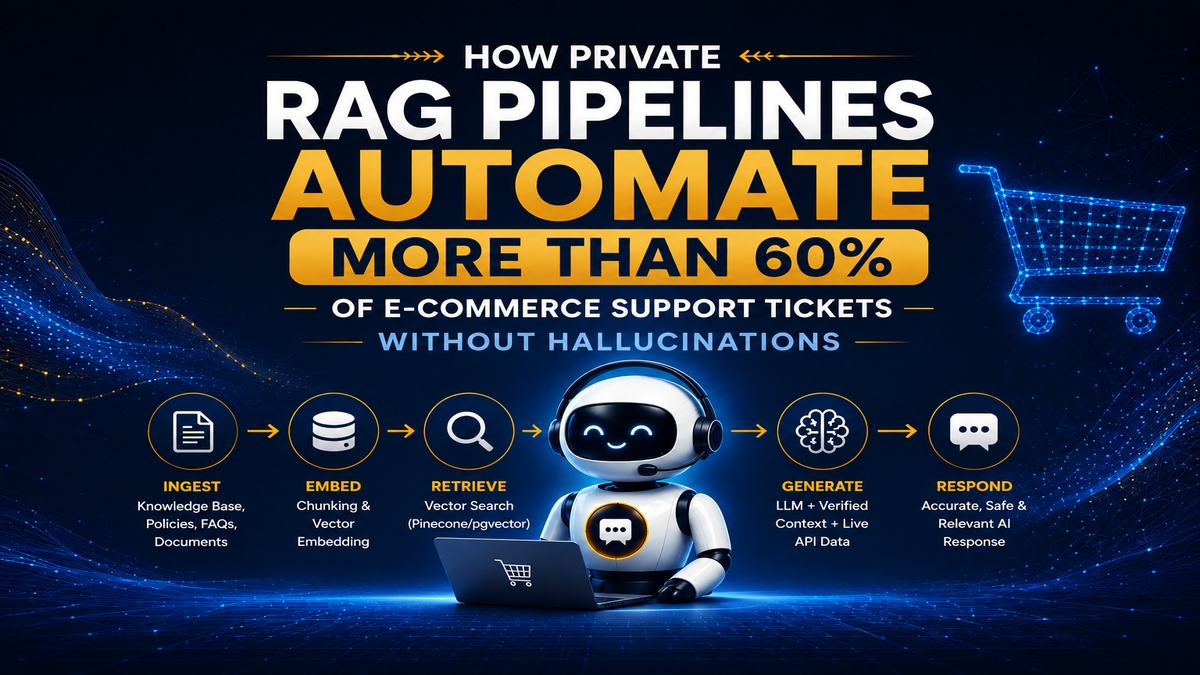
RAG Operational Flow
User Query $\rightarrow$ Embedding Engine $\rightarrow$ Vector Search (Pinecone/pgvector) $\rightarrow$ (Retrieved Facts) $\rightarrow$ User Query + Verified Facts + Live API Data $\rightarrow$ LLM Engine $\rightarrow$ Precise Support Response
Architectural Components of a Private Enterprise RAG Engine
A production-grade RAG pipeline consists of three core engineering layers: Data Ingestion & Vectorization, Context Orchestration, and Secure LLM Generation.
Overview of Core Execution Layers
Ingestion Layer: Policy Docs / Knowledge Base / FAQs $\rightarrow$ Chunking & Embedding $\rightarrow$ Vector Database
Retrieval Layer: Live Inquiry + Real-Time Order API $\rightarrow$ Vector Similarity Search $\rightarrow$ Context Assembly
Generation Layer: System Prompt + Context + Query $\rightarrow$ LLM Engine $\rightarrow$ Sanitized Output
1. Document Chunking & Vector Embedding Generation
Enterprise knowledge sources such as PDF return guides, internal support manuals, and policy databases are broken down into semantically discrete chunks (typically 256–512 tokens). These chunks are processed through specialized embedding models (e.g., text-embedding-3-large) to transform raw text into high-dimensional numerical vectors that represent semantic context.
These vector embeddings are stored in high-performance vector databases such as Pinecone or pgvector (PostgreSQL extension), indexed via Hierarchical Navigable Small World (HNSW) graphs for sub-10ms similarity searches.
2. Context Orchestration (LlamaIndex / LangChain)
When a customer submits a ticket, the context orchestrator executes a hybrid search model:
Dense Vector Retrieval: Searches vector databases to identify semantically relevant policy rules.
Sparse Keyword Search (BM25): Executes exact keyword matching for specific product SKUs, order IDs, or tracking numbers.
Real-Time API Interrogation: Queries internal commerce REST/GraphQL APIs asynchronously to retrieve live order status, carrier tracking details, and account permission parameters.
3. Strict Prompt Scaffolding and Hallucination Guardrails
The retrieved facts, real-time API responses, and original user query are injected into a highly structured prompt context. The prompt instructs the model to generate a response only using the provided context blocks.
Data Privacy, Security, and PII Sanitization Protocols
Deploying AI agents within enterprise commerce requires strict data protection compliance (GDPR, CCPA, PCI-DSS):
Local PII Redaction: Before text is passed to vector embedding models or external LLM gateways, an internal sanitization service (e.g., Microsoft Presidio) strips credit card numbers, email addresses, phone numbers, and street addresses.
Zero-Data-Retention Agreements: Enterprise LLM access must run through dedicated, private enterprise endpoints (such as Azure OpenAI Service) that enforce strict zero-data-retention and explicitly forbid using client data for base model retraining.
Role-Based Access Control (RBAC): Vector indices are tagged with metadata flags corresponding to customer account levels, ensuring general users cannot access restricted wholesale or enterprise B2B policy data.
Conclusion
Automating tier-1 customer support without risking brand reputation requires shifting away from generic generative chatbots toward private, enterprise-grade RAG pipelines. By coupling real-time vector search over internal knowledge bases with direct API access to live order data, enterprise brands can resolve over 60% of customer support tickets autonomously. Guardrailed by strict PII sanitization and fallback protocols, private RAG engines lower operational support costs while providing fast, accurate resolution for shoppers.