

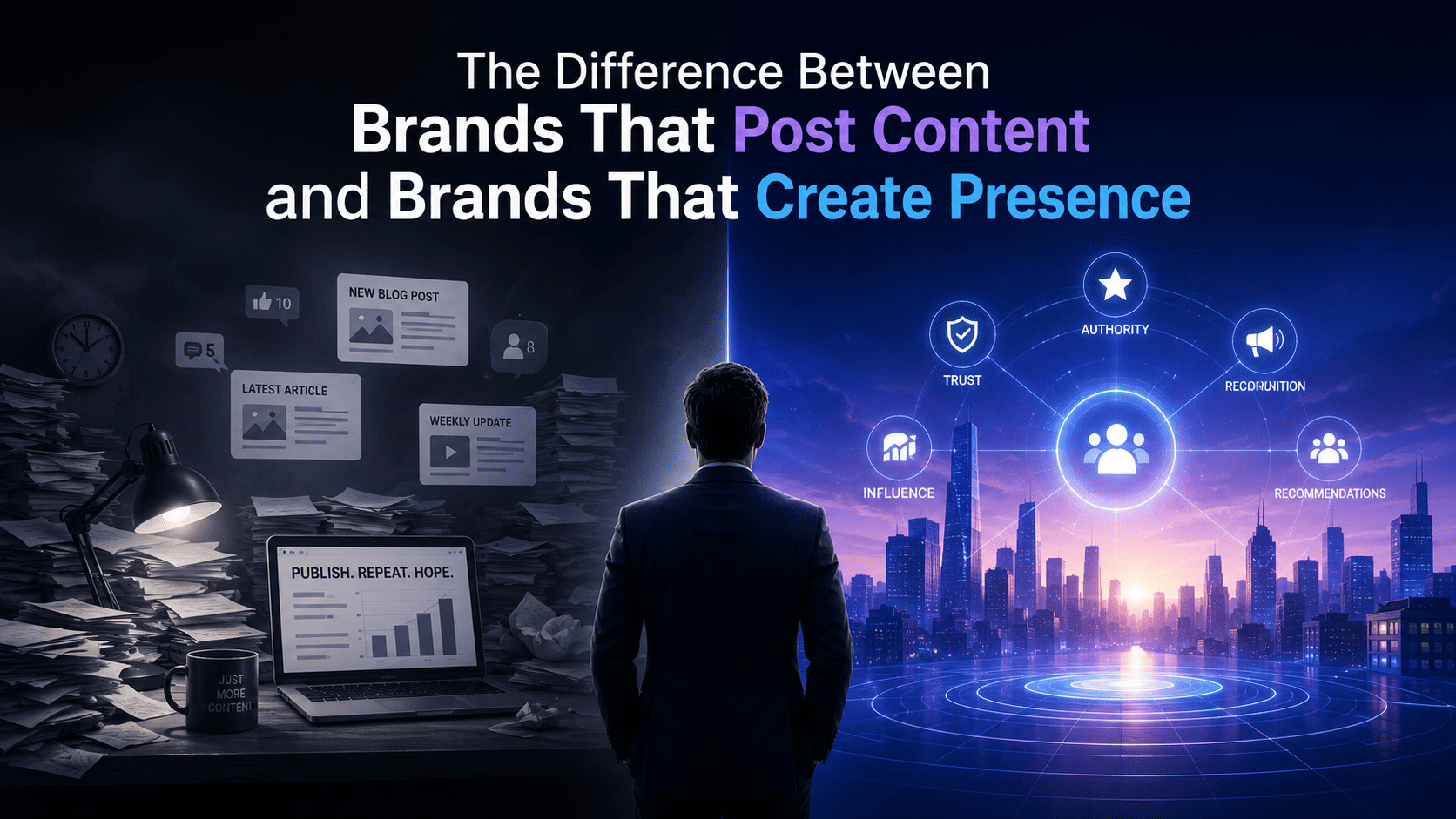
For more than a decade, marketing teams have been told that success is a numbers game.
Publish more blogs.
Post more on LinkedIn.
Upload more videos.
Create more social content.
Send more emails.
The assumption was simple: more content meant more visibility, more traffic, and ultimately more customers.
For a while, that strategy worked.
Search engines rewarded fresh content. Social media algorithms favored frequent posting. Brands that consistently published often outperformed those that remained silent.
Then something changed.
The internet didn't just become crowded—it became saturated.
Today, millions of articles are published every day. AI tools can generate thousands of blog posts in minutes. Every company has access to the same templates, the same SEO tools, the same keyword research platforms, and increasingly, the same language models.
Content has become abundant.
Attention has become scarce.
This shift marks one of the most significant transformations in modern marketing. The brands that continue to treat content as an output are finding it increasingly difficult to stand out. Meanwhile, a different group of companies is quietly pulling ahead—not because they publish more, but because they create something far more valuable.
They create presence.
Presence is what makes a brand recognizable before a customer ever visits its website. It's what earns mentions in conversations, recommendations in AI-generated answers, invitations to industry events, and trust from buyers long before a sales conversation begins.
In an era where discovery happens across Google AI Overviews, ChatGPT, LinkedIn, Reddit, YouTube, podcasts, newsletters, and private communities, presence has become a competitive advantage that content alone cannot deliver.
This article explores why the traditional content marketing playbook is no longer enough, what brand presence really means, and how organizations can build lasting authority in the age of AI-powered discovery.
The End of the Content Quantity Era
There was a time when simply publishing consistently gave brands a measurable competitive advantage. Search engines rewarded freshness, keyword optimization, and publishing frequency. Marketing teams built editorial calendars around volume, believing that every additional article increased the likelihood of attracting new customers.
That era is fading.
Today, the barrier to content creation has nearly disappeared. AI-powered writing tools can generate articles, social posts, product descriptions, and email campaigns in seconds. While this has increased efficiency, it has also flooded the digital landscape with content that looks remarkably similar.
The result is an attention economy where publishing more does not necessarily mean being noticed more.
Consumers are no longer overwhelmed by a lack of information. They are overwhelmed by an excess of it.
The brands that break through this noise are not those producing the most content—they are those creating the strongest signal.
Content Has Become Infrastructure, Not Strategy
Think about electricity in a modern office.
Electricity is essential, but it does not create competitive advantage. Every business has access to it.
Content is following a similar path.
Every company can now produce blogs, videos, newsletters, and social media posts at scale. The ability to create content is no longer a differentiator. It is the baseline expectation.
Competitive advantage now comes from what that content represents:
Expertise
Original thinking
Customer experience
Trust
Brand identity
Unique perspectives
Content supports these elements, but it cannot replace them.
Why Publishing More No Longer Guarantees Growth
Marketing dashboards often celebrate metrics like impressions, clicks, page views, and publishing frequency. While these indicators remain useful, they rarely tell the complete story.
Consider two organizations:
Company A publishes five articles every week, each optimized for search engines but largely repeating information already available online.
Company B publishes one deeply researched article each month, shares proprietary insights, hosts webinars, speaks at conferences, engages with its community, and earns citations from respected industry sources.
Which company is more likely to be remembered?
Which is more likely to earn trust?
Which is more likely to influence buying decisions?
Increasingly, it is Company B.
Search visibility may begin with content, but long-term influence is built through authority.
The Metrics That Actually Matter
Instead of focusing exclusively on publishing volume, forward-thinking organizations measure indicators such as:
Brand mentions
Direct website traffic
Returning visitors
Branded search volume
AI-generated citations
Share of voice
Community engagement
Earned media
Newsletter subscriptions
Executive thought leadership engagement
These metrics reflect whether a brand is becoming part of the market conversation rather than simply contributing more content to it.
What Brand Presence Really Means
Brand presence is often misunderstood as visibility. In reality, visibility is only one component.
A brand can be highly visible yet easily forgotten.
Presence is different.
Presence is the cumulative perception a market holds about your organization. It is built through repeated, meaningful interactions across channels and over time.
It answers questions such as:
Do people recognize your brand without explanation?
Are your executives seen as credible voices?
Do customers recommend you organically?
Are you cited in industry discussions?
Does AI associate your company with expertise in your category?
When these signals align, a brand moves beyond awareness and becomes part of the industry's mental landscape.
Presence Creates Preference
People rarely buy from the first company they discover.
They buy from the company they trust most.
Presence accelerates trust because familiarity reduces perceived risk.
This is why organizations that consistently educate, participate in industry conversations, publish original research, and demonstrate expertise often outperform competitors with larger advertising budgets.
Their reputation begins influencing decisions before the buying process officially starts.
AI Didn't Kill Content Marketing—It Changed What Wins
When generative AI entered mainstream marketing, many predicted the end of content marketing.
The reality is more nuanced.
AI hasn't made content irrelevant. It has made generic content invisible.
For years, businesses competed by answering common questions. If someone searched "How to improve ecommerce conversion rates," dozens of brands could produce nearly identical articles optimized for the same keywords.
Today, AI can generate those articles in seconds.
If your content simply summarizes information that already exists, it no longer creates competitive advantage. It becomes interchangeable.
The brands gaining momentum are publishing content that AI cannot easily replicate:
Original research
First-hand experience
Customer stories
Proprietary frameworks
Executive perspectives
Industry predictions
Data-backed insights
Contrarian opinions supported by evidence
These assets don't just attract readers—they shape conversations.
Discovery No Longer Begins with Google Alone
Search behavior has fundamentally changed.
Today's buyers might:
Ask ChatGPT for software recommendations.
Compare solutions using AI-powered search.
Watch YouTube reviews.
Read discussions on Reddit.
Follow industry experts on LinkedIn.
Listen to podcasts.
Subscribe to niche newsletters.
Join Slack or Discord communities.
By the time they visit your website, they may already have an opinion about your company.
Your brand is being evaluated long before someone lands on your homepage.
That's why presence matters.
Presence Is an Ecosystem, Not a Channel
Many organizations still organize marketing by channels.
SEO Team
Social Media Team
PR Team
Content Team
Email Team
Customers don't experience your business that way.
They experience one brand.
Whether they discover you through an AI-generated answer, a podcast interview, a LinkedIn post, a webinar, or a Google search, every interaction contributes to the same perception.
Presence is created when these touchpoints reinforce each other instead of operating independently.
Think of each piece of content as a signal.
One signal is easy to ignore.
Hundreds of consistent signals become a reputation.
The Five Pillars of Brand Presence
1. Expertise
People trust organizations that teach instead of sell.
Demonstrate expertise by:
Publishing original research
Sharing implementation lessons
Explaining industry changes
Documenting real client outcomes
Speaking at conferences
Contributing to industry discussions
Expertise answers the question:
"Should I listen to this brand?"
2. Consistency
Trust is built through repetition.
One excellent article won't establish authority.
Publishing consistently over months and years creates familiarity.
Consistency includes:
Visual identity
Messaging
Tone of voice
Publishing cadence
Leadership visibility
Customer experience
3. Credibility
Credibility cannot be claimed.
It must be earned.
Brands build credibility through:
Customer success stories
Independent reviews
Industry recognition
Partnerships
Certifications
Speaking engagements
Transparent communication
The strongest marketing asset is often what other people say about your company.
4. Community
Communities amplify presence.
The most influential brands don't simply publish.
They participate.
That means:
Responding to comments
Hosting discussions
Sharing customer stories
Encouraging user-generated content
Supporting industry events
Building professional networks
Communities transform audiences into advocates.
5. Memorability
Facts educate.
Stories stay with people.
Memorable brands have:
A distinct point of view
Recognizable language
Clear positioning
Consistent design
Human leadership
Original frameworks
People rarely remember statistics.
They remember ideas.
The Shift from Content Marketing to Presence Marketing
Traditional content marketing often asks:
"What should we publish this week?"
Presence marketing asks a different question:
"What should our market remember about us one year from now?"
That single shift changes everything.
Instead of chasing keywords alone, organizations begin creating assets that compound in value.
Examples include:
Annual industry reports
Benchmark studies
Signature frameworks
Research papers
Podcasts
Executive newsletters
Educational communities
Interactive tools
Industry events
Customer success libraries
These become intellectual property—not just content.
A Practical Framework for Building Brand Presence
Think of presence as a flywheel rather than a funnel.
Stage | Objective | Example Activities |
Discover | Become visible | SEO, AI optimization, LinkedIn, YouTube, PR |
Educate | Demonstrate expertise | Guides, webinars, research, newsletters |
Engage | Build relationships | Social conversations, events, communities |
Validate | Build trust | Reviews, case studies, testimonials, speaking engagements |
Advocate | Create ambassadors | Customer stories, referrals, executive influence |
Each stage reinforces the next.
The result isn't simply more traffic.
It's stronger market perception.
Common Mistakes That Prevent Brands from Building Presence
Even experienced marketing teams can undermine long-term authority by falling into predictable patterns.
Mistake 1: Publishing for algorithms instead of people
Content should answer genuine business questions, not simply satisfy keyword targets.
Mistake 2: Chasing every trend
Brands that constantly change direction struggle to establish a recognizable identity.
Mistake 3: Hiding executive expertise
Your leadership team is often your strongest differentiator.
If your experts never publish, speak, or engage publicly, competitors may become the voices your audience remembers.
Mistake 4: Measuring only traffic
Traffic without trust rarely creates sustainable growth.
Focus on:
Brand recall
Share of voice
Branded searches
Returning visitors
Community growth
Executive engagement
Referral traffic
Mistake 5: Treating every platform separately
Customers don't distinguish between your blog, LinkedIn page, YouTube channel, and podcast.
They experience one brand.
The Future of Brand Presence
Over the next five years, marketing success will increasingly depend on recognition rather than publication frequency.
Several trends are already emerging.
AI Will Become the First Point of Discovery
Customers will increasingly ask AI assistants for recommendations before opening a search engine.
Brands recognized as trusted entities will appear more frequently.
Expertise Will Outperform Volume
Hundreds of average articles will lose value.
Original insights will become significantly more valuable.
Executives Will Become Media Channels
Founders, CEOs, consultants, and subject-matter experts will increasingly drive brand visibility through their own voices.
People trust people before they trust logos.
Communities Will Matter More Than Audiences
Followers consume content.
Communities create conversations.
Conversations create influence.
Every Brand Will Need Intellectual Property
The most recognizable companies will own:
Proprietary methodologies
Benchmark reports
Industry indexes
Educational frameworks
Research programs
These assets become enduring competitive advantages.
Conclusion
For years, marketing teams measured success by output.
More blog posts.
More social updates.
More videos.
More campaigns.
But the future belongs to brands that are remembered, referenced, and trusted.
Publishing content is an activity.
Creating presence is a strategy.
One generates impressions.
The other shapes perception.
One competes for clicks.
The other earns consideration before buyers begin searching.
In an AI-driven world where information is abundant and attention is scarce, the brands that consistently demonstrate expertise, contribute original thinking, engage authentically with their communities, and build recognizable identities will outperform those focused solely on publishing volume.
The question is no longer:
"How much content are we creating?"
It's:
"What will people remember about us when they need to make a decision?"
That answer will determine which brands become market leaders in the years ahead.