

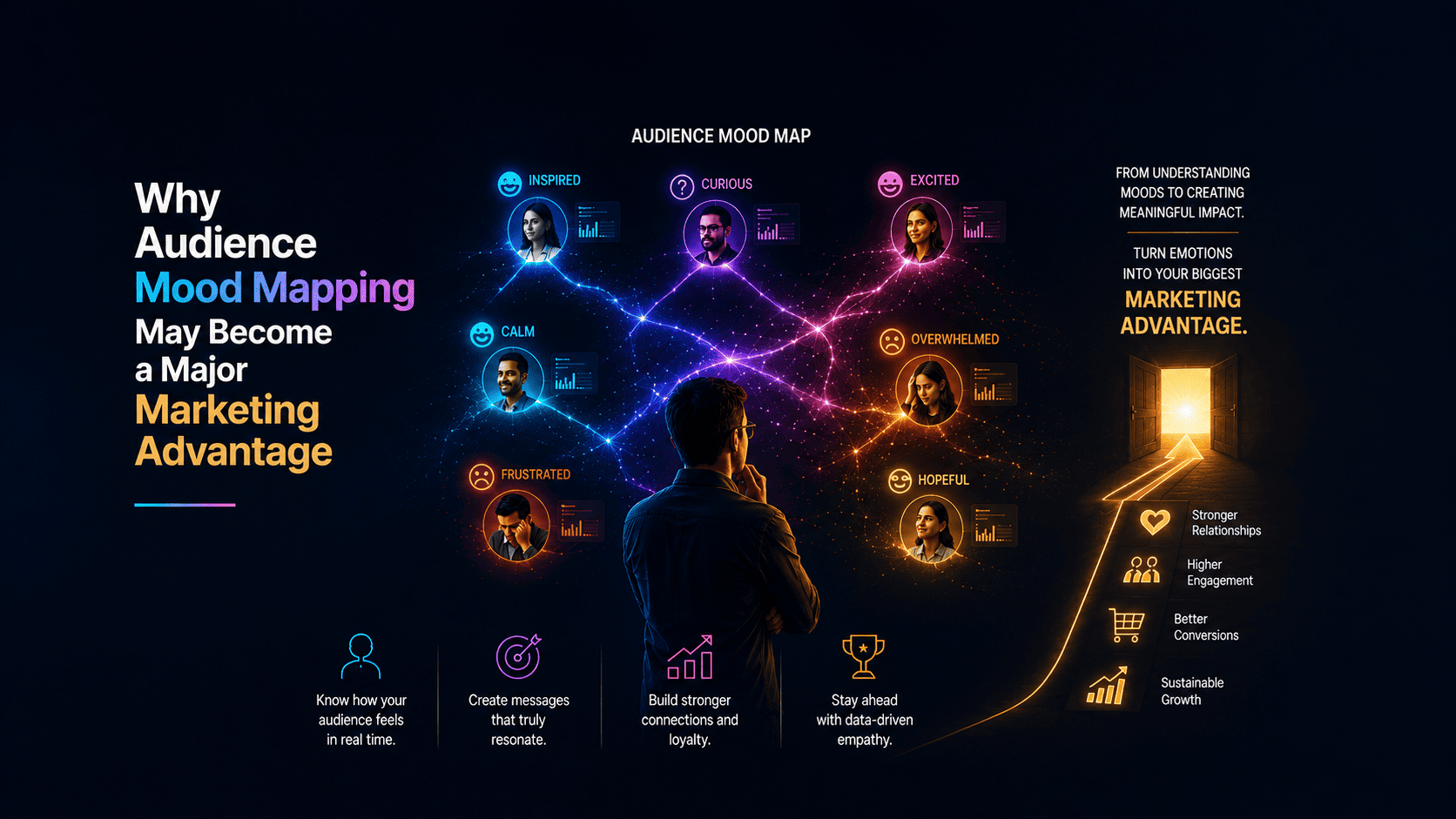
Marketing has never struggled to collect information.
Today's organizations can identify where visitors came from, which pages they viewed, what devices they use, how often they return, and what they purchased in the past. Modern analytics platforms generate an extraordinary amount of behavioral data, giving businesses unprecedented visibility into customer activity.
Yet one important question often remains unanswered:
What is motivating this interaction right now?
Two visitors can follow nearly identical digital paths while pursuing completely different objectives.
A procurement manager evaluating vendors before the next budgeting cycle may browse the same solution pages as an operations leader searching for an immediate replacement after a critical system failure. Their click patterns might appear remarkably similar, yet the decisions driving those actions—and the information they need—are fundamentally different.
Traditional personalization tends to emphasize historical behavior and customer attributes. Those insights remain valuable, but they are often retrospective. They explain where a customer has been, not necessarily where they are in their decision-making process today.
This is where the concept of Audience Mood Mapping introduces a different perspective.
Instead of asking only who a customer is, it encourages marketers to consider what circumstances are shaping the current interaction. The goal is not to interpret emotions or make intrusive assumptions. Rather, it is to recognize the practical context influencing a customer's priorities at a specific moment and adapt the experience accordingly.
As digital experiences become increasingly dynamic, brands that can respond intelligently to changing customer intent may create stronger engagement, smoother buying journeys, and more meaningful long-term relationships than those relying solely on static audience profiles.
Why Traditional Personalization Is No Longer Enough
For more than a decade, personalization has been one of digital marketing's defining priorities.
Organizations invested heavily in CRM platforms, customer data platforms, recommendation engines, automation software, and analytics tools to deliver increasingly relevant experiences. These investments transformed how brands communicate, making it possible to tailor messages based on purchase history, browsing activity, geographic location, industry, and countless other data points.
Those capabilities remain valuable.
The challenge is that they primarily explain past behavior.
Historical data can reveal what someone bought six months ago, which campaign generated a lead, or how frequently a customer visits a website. It is exceptionally good at describing patterns that have already occurred.
What it cannot always explain is why a visitor has arrived today.
The same customer who previously explored educational resources may now be comparing vendors before making a final decision. Another returning visitor could simply be searching for documentation after becoming an existing customer.
Treating both interactions as identical limits relevance.
Marketing becomes considerably more effective when it adapts to evolving customer intent rather than assuming previous behavior defines future needs.
Static Customer Profiles Cannot Reflect Dynamic Decision-Making
Most customer profiles are designed to provide consistency.
People rarely behave that way.
Business priorities shift with changing budgets, new leadership, operational challenges, competitive pressures, organizational restructuring, and market conditions. Even within a single buying journey, a customer's objectives may change multiple times before any purchasing decision is made.
A prospect researching industry trends today may become an active evaluator within a few weeks. A customer comparing pricing options may later return seeking implementation guidance after making a purchase.
These changes are entirely natural.
The limitation lies in expecting static audience segments to accurately represent continuously changing circumstances.
The more organizations rely exclusively on fixed profiles, the greater the likelihood that marketing experiences begin feeling repetitive, disconnected, or poorly timed.
Relevance depends less on assigning customers to permanent categories and more on recognizing how their priorities evolve from one interaction to the next.
What Is Audience Mood Mapping?
Audience Mood Mapping offers a complementary way of understanding customer behavior.
Rather than relying primarily on demographic characteristics or historical activity, it considers the broader decision-making context surrounding each interaction.
The term "mood" should not be interpreted as an attempt to identify emotions or psychologically analyze individuals.
Instead, it describes the practical mindset influencing a customer's immediate objective.
At any given moment, someone may be:
Exploring an unfamiliar topic
Comparing alternative solutions
Validating an existing recommendation
Responding to an urgent operational challenge
Building internal consensus
Preparing for procurement discussions
Looking for reassurance before committing to a purchase
Each situation represents a different informational need.
The products may remain unchanged.
The customer experience should not.
Organizations that recognize these changing contexts are better positioned to provide information that feels timely, useful, and proportionate to where the customer actually is within the decision-making process.
Understanding Context Without Guessing Emotions
One of the biggest misconceptions is that Audience Mood Mapping requires brands to identify emotions with precision.
That is neither practical nor necessary.
Instead, organizations can focus on observable signals such as:
Navigation patterns
Search behavior
Content consumption
Time spent evaluating solutions
Returning visits
Customer service interactions
Product comparison activity
These signals help infer what kind of support or information may be most useful without making assumptions about an individual's emotional state.
Why Customer Mindset Is Becoming a Competitive Differentiator
Digital experiences are no longer evaluated only against direct competitors.
Every interaction customers have whether with a retailer, streaming platform, financial institution, or enterprise software provider shapes their expectations for every other brand they engage with.
As a result, relevance has become less about personalization in isolation and more about reducing unnecessary effort.
Customers increasingly expect websites, applications, and service providers to anticipate the type of information they need without forcing them to repeat the same journey each time they return.
Understanding customer mindset helps organizations answer practical questions that traditional audience segmentation often cannot:
Is this visitor learning or evaluating?
Would educational guidance be more valuable than promotional messaging?
Is detailed technical information appropriate at this stage?
Does the customer require reassurance before making a decision?
Is this the right moment to introduce direct sales engagement?
Answering these questions allows marketing experiences to evolve naturally alongside customer intent rather than remaining fixed around historical attributes.
When organizations consistently reduce friction in this way, they create experiences that feel less like targeted marketing and more like thoughtful assistance.
Customer Intent Changes Throughout the Journey
Intent is not fixed.
It evolves.
A visitor may begin by researching general concepts, later compare vendors, request demonstrations, negotiate pricing, and eventually become a long-term customer.
Each stage represents a different mindset.
Delivering identical messaging across every stage reduces relevance.
Adaptive experiences increase engagement because they acknowledge changing customer needs rather than treating every interaction as identical.
From Personalization to Context-Aware Experiences
For years, the objective of digital marketing was straightforward: make every interaction feel personal.
Brands greeted visitors by name, recommended products based on previous purchases, triggered automated emails after specific actions, and segmented audiences into increasingly refined groups. These approaches represented a significant improvement over one-size-fits-all marketing and continue to deliver value today.
Yet personalization alone no longer guarantees relevance.
Two customers can share remarkably similar profiles while arriving with entirely different priorities. One may be conducting early research for a project that won't begin for several months. Another may be evaluating vendors because an immediate business problem demands action.
Showing both visitors the same content simply because they belong to the same audience segment overlooks the most important variable the reason behind the visit.
This is where marketing begins to shift from personalization toward contextual experiences.
Rather than relying primarily on who a customer is, organizations increasingly need to understand what the customer is trying to accomplish during a specific interaction. That subtle change reshapes how content, messaging, and digital journeys should be designed.
The objective is no longer to personalize every experience.
It is to make every experience feel appropriate to the customer's immediate situation.
Context Is Becoming the New Currency
Organizations that recognize customer context create experiences that feel intuitive.
Instead of presenting identical messaging to every visitor, they adapt based on behavioral signals.
Examples include:
Educational content for early-stage researchers
Product comparisons for evaluation-stage buyers
Implementation guides for decision-makers
Success stories for customers seeking reassurance
Support resources for existing clients
Each interaction becomes more relevant because it aligns with the customer's likely objective.
The result isn't just higher engagement.
It creates stronger trust.
Designing an Audience Mood Mapping Framework
Audience Mood Mapping should not be viewed as an attempt to predict human behavior with perfect accuracy.
Instead, it offers a structured method for interpreting observable signals and responding with experiences that better support the customer's current objective.
Rather than organizing journeys exclusively around demographics or lifecycle stages, organizations can map interactions around evolving decision contexts.
A practical framework can be organized into five progressive mindsets.
Stage 1 – Discovery Mindset
Customers are exploring a topic or identifying a challenge.
Typical behaviors include:
Reading educational articles
Searching broad industry topics
Watching introductory videos
Browsing multiple categories
Recommended Experience
Educational content
Industry guides
Glossaries
Interactive learning resources
Explainer videos
The objective is to build understanding not push a sale.
Stage 2 – Evaluation Mindset
Customers understand the problem and are comparing potential solutions.
Typical behaviors include:
Comparing products
Reading feature pages
Reviewing pricing
Visiting competitor websites
Downloading buying guides
Recommended Experience
Comparison charts
Feature breakdowns
Product demonstrations
Customer reviews
ROI calculators
The goal is to reduce uncertainty.
Stage 3 – Decision Mindset
Customers are close to making a purchase.
Typical behaviors include:
Multiple return visits
Pricing page activity
Contact form submissions
Demo requests
Proposal downloads
Recommended Experience
Clear pricing
Implementation timelines
Security information
Onboarding process
Customer success stories
Here, simplicity often outperforms complexity.
Stage 4 – Success Mindset
The relationship doesn't end after purchase.
Customers now want to succeed.
Recommended experiences include:
Onboarding resources
Tutorials
Knowledge centers
Best practices
Customer communities
Helping customers achieve results strengthens retention and advocacy.
Stage 5 – Advocacy Mindset
Satisfied customers become one of a brand's most valuable growth channels.
Organizations should encourage:
Reviews
Referrals
Testimonials
Community participation
Case studies
Product feedback
The strongest marketing often comes from customers themselves.
Comparison: Traditional Personalization vs. Audience Mood Mapping
Traditional Personalization | Audience Mood Mapping |
Focuses on customer profile | Focuses on customer context |
Uses historical data | Uses current behavioral signals |
Static customer segments | Dynamic intent recognition |
Same experience for similar profiles | Adaptive experiences based on likely objectives |
Optimizes messaging | Optimizes customer understanding |
Measures clicks and conversions | Measures engagement, trust, and progression |
Common Mistakes When Implementing Audience Mood Mapping
While the concept is promising, implementation requires thoughtful execution.
Mistake 1: Confusing Mood with Emotion
Audience Mood Mapping is not about predicting feelings.
It focuses on understanding context and intent based on observable behavior.
Making assumptions about emotions can lead to irrelevant or intrusive experiences.
Mistake 2: Over-Personalization
Customers appreciate relevance.
They don't appreciate feeling watched.
Experiences should be helpful rather than overly specific or invasive.
Maintaining transparency and respecting privacy are essential.
Mistake 3: Ignoring Customer Intent
Behavioral signals should always be interpreted within the broader customer journey.
Viewing individual actions in isolation often produces inaccurate conclusions.
Mistake 4: Treating Every Customer the Same
Two visitors arriving from the same campaign may have entirely different objectives.
Adaptive experiences recognize this variation instead of relying on broad audience segments.
Mistake 5: Measuring Only Conversion Rates
Conversions are important.
But they don't capture the entire customer experience.
Organizations should also evaluate:
Time to decision
Customer satisfaction
Repeat engagement
Content interaction
Feature adoption
Customer retention
Referral activity
These indicators often reveal whether experiences are genuinely improving.
Future Trends
Audience Mood Mapping is still an emerging concept, but several developments suggest it will become increasingly important.
Adaptive Websites
Future digital experiences will likely adjust content, navigation, and messaging based on behavioral context instead of relying solely on static personalization.
Journey Intelligence
Organizations will place greater emphasis on understanding progression throughout the customer lifecycle rather than optimizing isolated touchpoints.
Experience-Led Marketing
Marketing success will increasingly be measured by how effectively brands reduce customer effort and build confidence throughout decision-making.
Human-Centered AI
Artificial intelligence will become more effective at identifying patterns and recommending relevant experiences, while human teams continue to define ethical boundaries, messaging, and strategy.
Trust as a Competitive Advantage
As personalization becomes more sophisticated, customers will increasingly reward organizations that use data responsibly and communicate transparently.
Conclusion
For years, personalization has been driven by customer profiles, historical behavior, and demographic data.
Those approaches remain valuable, but they are no longer enough on their own.
The next evolution of customer experience lies in understanding context—not just identity.
Audience Mood Mapping offers a practical way to interpret behavioral signals, recognize likely customer intent, and deliver experiences that align with what people need at that moment.
It isn't about predicting emotions or collecting more personal information.
It's about reducing friction, increasing relevance, and creating interactions that feel thoughtful rather than generic.
As digital experiences become increasingly intelligent, the brands that succeed will not necessarily know the most about their customers.
They will understand them the best.