

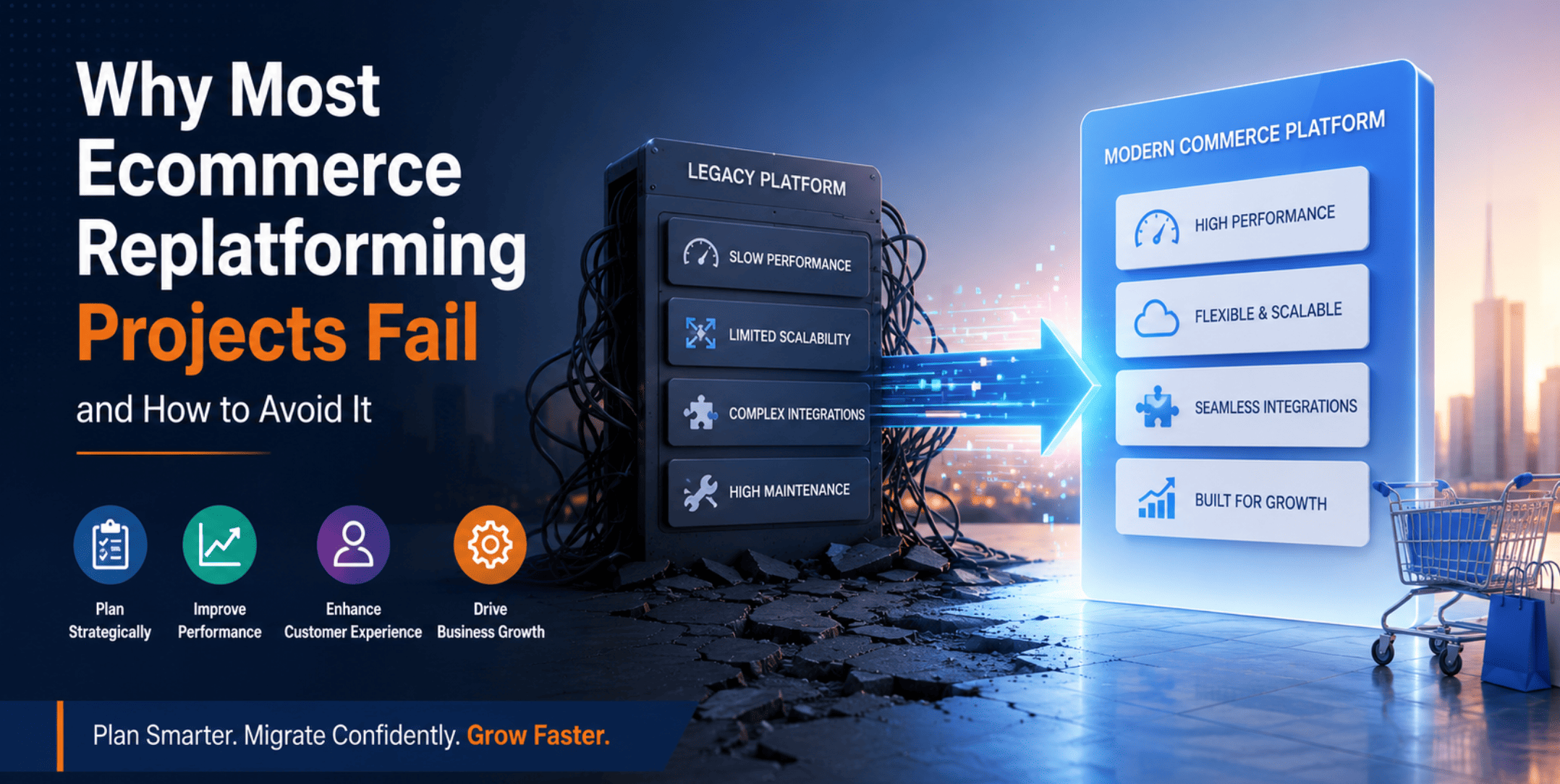
For many growing ecommerce businesses, there comes a point when the existing platform can no longer support future ambitions.
What once seemed like the perfect solution begins to show its limitations. Site performance starts to decline, integrations become increasingly complex, marketing teams struggle to launch campaigns efficiently, and customer experience improvements take longer than they should.
At this stage, organizations often begin exploring ecommerce replatforming. A successful replatforming project can unlock significant business value, including improved website performance, increased conversion rates, better operational efficiency, and enhanced customer experiences.
However, ecommerce replatforming is also one of the most complex digital transformation initiatives a business can undertake.
According to industry studies, a significant percentage of digital transformation and platform migration projects either fail to achieve their objectives or exceed expected timelines and budgets.
The reasons are rarely technical alone. Most failed replatforming initiatives result from poor planning, unclear business objectives, inadequate stakeholder alignment, and a lack of focus on long-term business outcomes.
In this guide, we'll examine why ecommerce replatforming projects fail, how businesses can avoid common mistakes, and what organizations should consider when planning their next commerce transformation.
What Is Ecommerce Replatforming?
Ecommerce replatforming is the process of migrating an online store from one ecommerce platform or technology architecture to another.
This may involve:
Migrating from a legacy ecommerce platform
Upgrading to a more scalable solution
Moving to a headless commerce architecture
Rebuilding customer experiences
Modernizing backend systems
Improving operational workflows
The objective is not simply to replace technology.
Successful replatforming initiatives create a stronger foundation for growth, innovation, customer experience, and operational efficiency.
The Real Reasons Ecommerce Replatforming Projects Fail
Many organizations assume platform selection is the most important part of a migration project.
In reality, the platform itself is rarely the reason projects fail.
Most failures occur long before implementation begins.
Undefined Business Goals
One of the most common mistakes is treating replatforming as a technology project instead of a business initiative.
Organizations often focus on features rather than outcomes.
Examples include:
"We need a newer platform."
"Our competitors use this technology."
"The current platform feels outdated."
These are not business objectives.
Successful projects define measurable goals such as:
Improve conversion rate by 15%
Reduce page load times
Increase operational efficiency
Improve marketing agility
Support international expansion
Reduce maintenance costs
Without clear objectives, project teams struggle to prioritize decisions and measure success.
Poor Migration Planning
Migration planning is frequently underestimated.
An ecommerce platform is rarely a standalone system.
Most businesses rely on:
ERP platforms
CRM systems
Payment providers
Inventory systems
Product information management platforms
Marketing automation tools
Customer support software
Failing to account for these dependencies can create operational disruption during and after launch.
A comprehensive migration strategy should address:
Data migration
System integrations
Customer account migration
Product catalog migration
Order history preservation
Operational workflows
SEO Is Treated as an Afterthought
One of the most expensive mistakes organizations make during replatforming is neglecting SEO.
Businesses often invest heavily in design, development, and infrastructure while overlooking organic search visibility.
Common consequences include:
Traffic loss
Revenue decline
Ranking drops
Broken URLs
Indexing issues
Many ecommerce websites generate a substantial portion of revenue from organic search.
A poorly managed migration can erase years of SEO progress within days.
SEO planning should begin during the earliest phases of the project.
Carrying Technical Debt Into the New Platform
Replatforming provides an opportunity to eliminate inefficiencies.
Unfortunately, many organizations simply replicate existing problems on a new platform.
Examples include:
Poor product data structures
Inefficient workflows
Redundant integrations
Outdated processes
Legacy customizations
Instead of modernizing operations, they recreate technical debt in a new environment.
The result is higher costs with limited business improvement.
Lack of Stakeholder Alignment
Successful replatforming projects require collaboration across multiple departments.
Key stakeholders often include:
Marketing
Ecommerce
Operations
Customer Support
IT
Finance
Leadership
When teams are not aligned, priorities conflict and project complexity increases.
Cross-functional planning is essential for long-term success.
Signs It's Time to Replatform
Not every ecommerce business needs a new platform.
However, there are clear indicators that suggest modernization should be considered.
Website Performance Is Limiting Growth
Slow websites create friction throughout the customer journey.
Common symptoms include:
High bounce rates
Poor mobile performance
Reduced engagement
Lower conversion rates
If performance improvements require significant workarounds, the underlying platform may be part of the problem.
Marketing Teams Cannot Move Quickly
Modern marketing requires speed and flexibility.
If marketing teams depend heavily on developers for:
Landing pages
Promotions
Content updates
Campaign launches
the organization may be losing valuable opportunities.
Commerce Operations Have Become Complex
Growth often introduces operational complexity.
Warning signs include:
Manual processes
Disconnected systems
Integration challenges
Data inconsistencies
These issues frequently indicate that existing technology can no longer support business requirements.
Customer Experience Expectations Have Changed
Customer expectations continue to evolve.
Modern consumers expect:
Personalized experiences
Fast loading pages
Seamless checkout
Mobile optimization
Omnichannel consistency
Legacy platforms often struggle to deliver these experiences efficiently.
International Expansion Is Becoming Difficult
Businesses expanding into new markets often require:
Multiple storefronts
Local currencies
Regional content
Market-specific experiences
If global growth becomes increasingly difficult to support, a new architecture may be necessary.
Creating a Successful Replatforming Roadmap
Successful ecommerce migrations follow a structured process.
Below is a proven framework used by leading digital commerce organizations.
Phase 1 – Discovery & Business Alignment
Before evaluating technology, organizations should define:
Business objectives
Customer experience goals
Operational requirements
Growth projections
Technical constraints
This phase establishes the foundation for decision-making.
Phase 2 – Architecture & Platform Evaluation
Once requirements are defined, organizations can evaluate suitable platforms.
Key evaluation criteria include:
Scalability
Flexibility
Total cost of ownership
Integration capabilities
Performance
Security
Future roadmap
Platform decisions should support business objectives rather than short-term feature comparisons.
Phase 3 – Data & Migration Planning
Migration planning should include:
Product Data
Catalogs, attributes, categories, and media assets.
Customer Data
Accounts, preferences, subscriptions, and profiles.
Historical Orders
Past transactions and reporting requirements.
Content Assets
Blogs, landing pages, SEO content, and media libraries.
Phase 4 – Design & Experience Modernization
Replatforming should not simply replicate the existing storefront.
This phase should focus on:
UX improvements
Mobile optimization
Navigation enhancements
Checkout optimization
Accessibility improvements
Customer experience should be a primary success metric.
Phase 5 – Quality Assurance & Testing
Testing should include:
Functional testing
Performance testing
Security validation
Integration testing
User acceptance testing
Organizations should allocate sufficient time for validation before launch.
Phase 6 – Launch & Optimization
Launch is not the finish line.
Successful businesses continue monitoring:
Conversion rates
SEO performance
Site speed
Customer feedback
Operational workflows
Continuous optimization drives long-term value.
SEO Considerations During Migration
SEO is often one of the most overlooked components of ecommerce replatforming.
Protecting organic visibility requires careful planning.
Redirect Mapping
Every important URL should have a corresponding redirect strategy.
Key assets include:
Product pages
Category pages
Blog content
Landing pages
Improper redirects frequently lead to traffic loss.
Metadata Preservation
Preserve:
Title tags
Meta descriptions
Canonical tags
Structured data
Header hierarchy
Search engines rely on these signals to understand content.
Content Preservation
Content migration should include:
Product descriptions
Buying guides
Blog content
Category copy
Content often represents years of accumulated SEO value.
Site Architecture Optimization
Migration creates an opportunity to improve:
Internal linking
Navigation structure
URL hierarchy
Content organization
These improvements can strengthen long-term search visibility.
Performance Optimization
Site speed remains a critical ranking and user experience factor.
Optimization should include:
Image compression
Code optimization
Caching strategies
Core Web Vitals improvements
Faster experiences benefit both SEO and conversions.
Selecting the Right Commerce Architecture
Platform selection should align with business goals, operational requirements, and future growth plans.
Below are the most common options organizations evaluate.
Shopify
Shopify has become one of the most widely adopted ecommerce platforms globally.
Best suited for:
Fast-growing brands
Direct-to-consumer businesses
Mid-market organizations
Advantages include:
Ease of use
Large app ecosystem
Fast deployment
Strong security
Potential limitations may arise for highly customized enterprise requirements.
Adobe Commerce
Adobe Commerce is designed for organizations with more complex commerce requirements.
Best suited for:
Enterprise businesses
Multi-store operations
Complex product catalogs
Advantages include:
Extensive customization
Enterprise capabilities
Advanced B2B functionality
Implementation complexity is generally higher than SaaS-based platforms.
Headless Commerce
Headless commerce separates frontend customer experiences from backend commerce operations.
Best suited for:
Experience-driven brands
Enterprise organizations
Businesses prioritizing flexibility
Advantages include:
Faster performance
Greater customization
Omnichannel capabilities
Future scalability
Headless commerce is increasingly becoming the preferred architecture for organizations pursuing long-term digital transformation.
How Radianzz Helps Businesses Navigate Ecommerce Replatforming
Replatforming projects require expertise across strategy, architecture, design, development, integrations, and optimization.
Radianzz helps organizations modernize digital commerce ecosystems through:
Ecommerce Strategy & Consulting
Defining business goals, technology requirements, and transformation roadmaps.
Ecommerce Replatforming Services
Managing migrations while minimizing operational disruption.
Headless Commerce Development
Building scalable, high-performance customer experiences.
Systems Integration
Connecting commerce ecosystems with ERP, CRM, marketing, and operational platforms.
UX & Conversion Optimization
Improving customer journeys and conversion performance.
Ongoing Commerce Support
Helping organizations continuously evolve their commerce capabilities.
Related Resources:
Ecommerce Services
Development Services
Ecommerce Case Studies
Headless Commerce Solutions