

Years have passed since online shopping started climbing fast. Still, the tools behind most digital shops lag behind what shoppers now expect.
Nowadays people want an e-commerce site that does more than just work. A smooth journey matters, one where pages load almost instantly because waiting feels outdated. Personal touches make a difference, turning visits into something familiar. Moving between devices should feel natural, not jarring or disjointed. Checking out needs to flow without hurdles or surprise steps. Each interaction with a brand has to match the last, no matter where it happens.
While companies push to move faster, they also wrestle with rising demands to adapt on short notice. Not far behind, marketing groups must roll out promotions within days instead of waiting weeks. Often, product units want room to try fresh approaches without heavy roadblocks. Down the line, tech leads look for systems that grow smoothly, avoiding expensive rebuilds every couple years.
What Is Composable Commerce?
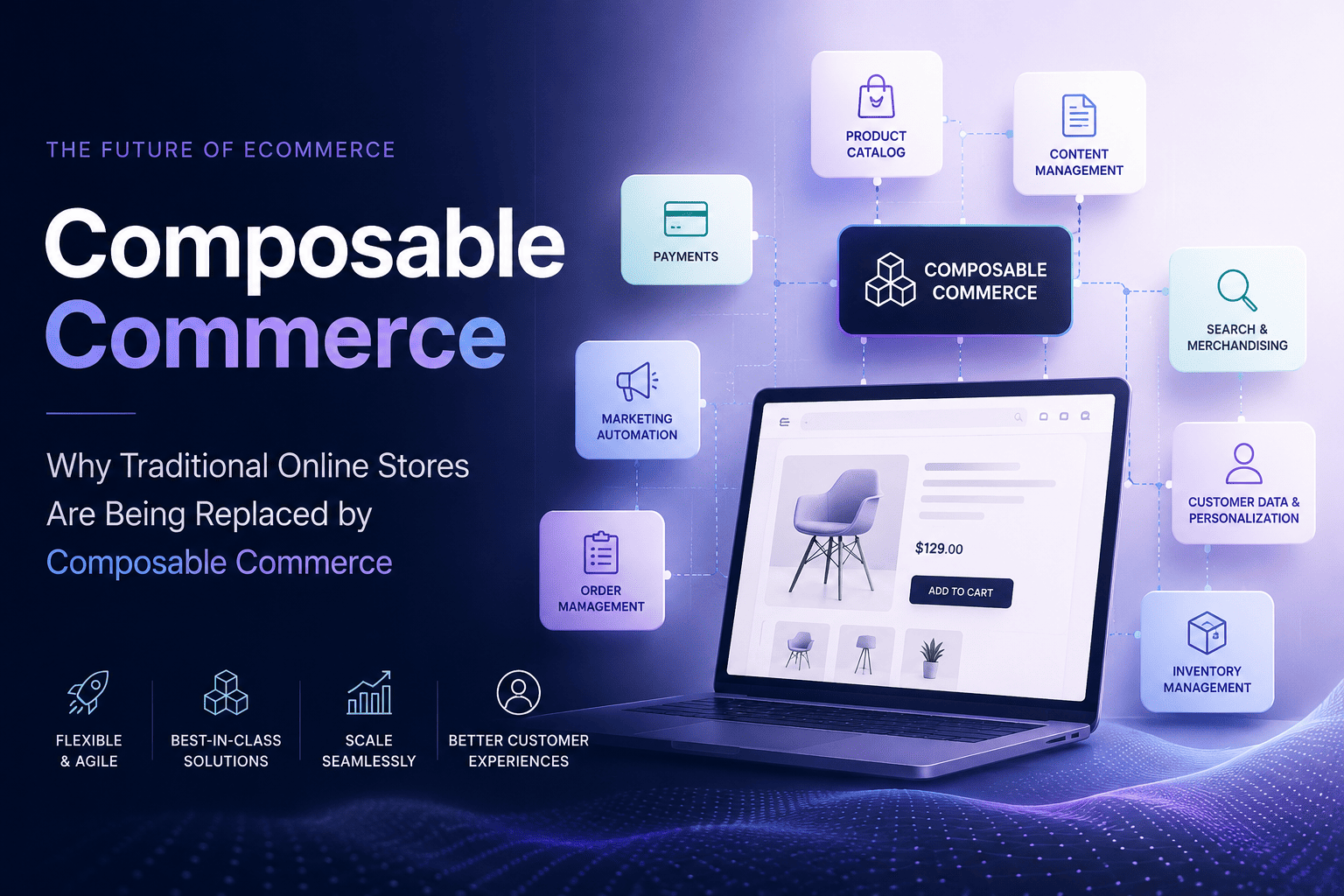
One piece at a time, companies build their online stores using separate tools that do one job well. Rather than picking a giant system meant to handle everything, they mix different specialized parts. Each tool connects where needed, forming a setup shaped by actual needs. This way, choices come from what works, not what comes bundled.
Instead of relying on a single platform to handle everything, companies might pick separate tools tailored to particular tasks like:
Product catalog management
Content management
Search and merchandising
Personalization
Payments
Customer data management
Marketing automation
Inventory management
Order processing
These systems communicate through APIs, creating a modular ecosystem that can evolve as business needs change.
The Shift from Monolithic to Modular
Frontend design ties closely to backend functions on many older online stores. Instead of working separately, each part - like payments or content updates - runs through one central system. Checkout steps follow the same pattern as inventory tracking. Content changes depend directly on how the tech layer is built.
Integrations plug into a single core rather than standing alone.
Though simpler at first, scaling often brings problems when companies expand.
Out of the blue, businesses started swapping stiff setups for flexible blocks - each piece now shifts alone, free from dragging everything else down. Suddenly, one upgrade does not freeze the whole system in place.
The Role of API-First Architecture
Building on API-first design creates the base for flexible commerce systems.
One system talks to another through APIs, letting them swap information without hiccups. Data flows between separate platforms thanks to these connections working quietly behind the scenes.
With this, companies can link various tools without losing grip on how their shopping systems run. Flexibility stays intact as different tech works together behind the scenes.
Technology shapes itself around how companies work, not the other way. Each setup bends tools to match real tasks people do every day.
Why Traditional Ecommerce Platforms Are Struggling
Years go by, yet plenty of businesses stick with online stores built half a decade ago - some even older, dating back ten or more. Though time moves forward, their systems stay frozen in place, running on software that feels ancient now. Old setups keep ticking, patched together, holding on through updates that barely fit. Fifteen years might pass, but the platform remains, like furniture inherited and never replaced.
Though these systems still work fine, limitations tend to creep in - holding back fresh ideas along with company expansion.
Slow Innovation Cycles
Faster changes mean better results in today's online stores. How a business reacts can shape its path. Shifting directions smoothly often leads to stronger performance. Those who adjust on the fly tend to stay ahead. Movement matters more than speed sometimes. Staying still is riskier than trying something new.
Marketing teams frequently need to:
Launch new campaigns
Create landing pages
Test customer journeys
Introduce promotional experiences
Most old-style online stores need heavy tech help for such tasks.
So it goes - tiny updates might need weeks, sometimes stretching into months, before they go live.
When things move fast, falling behind happens if you can’t keep up. Markets shift quick. Customers want new stuff all the time. Moving slow means others pull ahead. Falling out of step hurts chances to stay relevant.
Platform Limitations
Back then, online shopping hadn’t yet grown into the tangled web it is today. Most old-school ecommerce systems came to life before that shift even began. Their blueprints reflect simpler times - when websites did one thing, slowly. Complexity wasn’t built in because it didn’t exist out there. These platforms assumed fewer devices, slower change. The world moved differently, so their design followed suit.
Today's businesses require capabilities such as:
Omnichannel commerce
Subscription experiences
Advanced personalization
AI-powered recommendations
Unified customer data
Attempting to extend legacy platforms to support these capabilities often increases complexity and technical debt.
Scalability Challenges
Growth introduces new operational requirements.
Businesses may need to:
Expand internationally
Launch multiple storefronts
Support higher transaction volumes
Integrate new technologies
When demands grow, many single-piece setups can’t keep up without issues.
It often happens that what helped a company grow at first later slows it down. The setup that worked well in the beginning might not keep up when things get bigger. When size increases, old structures can start causing problems instead of helping. What once supported progress begins to block new steps forward. Growth reveals weaknesses hidden during simpler times.
Vendor Lock-In
Stuck using just one provider - that's what often happens with old-style online stores. Locked into their system, moving elsewhere feels nearly impossible.
One supplier shapes how companies plan ahead, set prices, work within tech boundaries. Their direction steers everything, quietly controlling moves behind the scenes. Decisions hinge on what that provider allows, limits appear where flexibility fades. Price shifts ripple through operations without warning. Tech rules narrow options over time. Dependence grows slowly, almost unnoticed.
Over time, leaning on this too much might limit options while raising the cost of new ideas. Though useful now, it could slow changes later simply by locking things in place.
The Business Benefits of Composable Commerce
More businesses choose composable commerce because it delivers clear results, not just because it's new tech. What matters most is what works - performance shows the way forward. Shifts happen where gains appear. Real impact pushes change more than tools themselves ever could.
Faster Customer Experiences
Faster sites shape how users act online. Speed changes choices people make while browsing.
Research consistently shows that slow-loading websites result in:
Higher bounce rates
Lower engagement
Reduced conversion rates
Frontend speed gets a boost when it runs free from backend limits, thanks to modular setups. These structures let companies roll out shop interfaces quicker than before. Speed thrives where pieces work apart yet fit together. Separate layers mean changes happen fast without breaking things. Performance gains come easier when one part doesn’t drag down another.
Faster performance often leaves customers more pleased, which can open doors to greater sales chances..
Improved Conversion Rates
These days, how shoppers feel about buying online shapes whether a store thrives. Success often ties back to the moments people spend clicking, waiting, then unboxing.
Composable commerce enables organizations to:
Personalize experiences
Optimize customer journeys
Improve search functionality
Streamline checkout experiences
A shift like this might actually boost how many people convert. What changes show up in the results could surprise you.
Instead of settling for what the system allows, companies tweak interactions over time with focused tools. Still, progress comes not from rules but from adapting each step along the way.
Better Content Flexibility
Content plays a critical role in modern commerce.
Marketing teams increasingly require the ability to create:
Landing pages
Product launches
Campaign microsites
Educational content
Interactive experiences
Composable architectures provide greater content flexibility by separating content management from commerce operations.
This allows marketing teams to move faster while reducing development dependencies.
Faster Experimentation
Innovation requires experimentation.
Organizations need the ability to test:
New experiences
Merchandising strategies
Customer journeys
Promotional offers
Composable commerce makes experimentation easier because individual components can be modified without disrupting the entire platform.
This creates a culture of continuous optimization.
Future-Proof Technology Investments
Technology evolves rapidly.
Out of nowhere, companies using composable commerce can plug in new tech as it shows up - no need to scrap what they already run. A fresh piece here, an upgrade there, all while keeping systems live. Instead of waiting years, changes happen piece by piece. When something better appears, swapping in just one part does the job. This way, old platforms don’t hold progress back.
Over time, this cuts down on potential problems while keeping tech spending secure.
When Should Businesses Consider Replatforming?
Not every organization needs to move to a composable architecture immediately.
However, certain indicators suggest it may be time to evaluate a new approach.
Decision Framework - Consider Replatforming If:
Website Performance Is Consistently Poor
A sluggish experience drags down how happy customers feel, while also shrinking income. What people notice right away affects their choices just as much as what happens behind the scenes.
Marketing Teams Depend Heavily on Developers
When regular changes need tech help, smooth operations take a hit.
Innovation Cycles Are Too Slow
Faster moves in rolling out fresh offerings help companies stay ahead. Slowness drags performance down.
Multiple Systems Are Difficult to Integrate
Disconnected technology ecosystems create operational complexity and inefficiencies.
Customer Experience Is Limited by Platform Constraints
Technology should support business goals, not restrict them.
International Expansion Is Becoming Difficult
Global commerce requires flexibility across regions, languages, currencies, and customer experiences.
Questions Leadership Teams Should Ask
Is our platform helping or limiting growth?
Can we launch new customer experiences quickly?
Are we dependent on a single vendor?
Can our architecture support future business models?
Are operational costs increasing unnecessarily?
The answers to these questions often reveal whether replatforming should become a strategic priority.
Composable Commerce and the Rise of AI-Powered Ecommerce
One of the strongest arguments for composable commerce is its ability to support emerging technologies.
Artificial Intelligence is transforming ecommerce through:
Personalized recommendations
Intelligent search
Dynamic merchandising
Customer support automation
Predictive analytics
Organizations operating on rigid legacy platforms often struggle to integrate these capabilities effectively.
Composable architectures provide the flexibility necessary to adopt AI innovations as they emerge.
As AI continues to reshape customer expectations, adaptable commerce ecosystems will become increasingly important.
How Radianzz Helps Brands Modernize Commerce Ecosystems
Modern commerce transformation requires more than selecting the right technology.
Successful ecommerce modernization combines strategy, user experience, architecture, integration, and optimization.
Radianzz helps organizations navigate this transformation through:
Ecommerce Strategy & Consulting
Assessing business goals, operational requirements, and technology ecosystems to develop modernization roadmaps.
Headless Commerce Development
Building scalable customer experiences that separate frontend experiences from backend commerce operations.
Ecommerce Replatforming
Supporting organizations through platform migrations while minimizing disruption and preserving business continuity.
Systems Integration
Connecting commerce platforms with ERP, CRM, PIM, marketing, and operational systems.
Performance Optimization
Improving speed, usability, and customer experience across digital channels.
Ongoing Commerce Innovation
Helping businesses continuously evolve their ecommerce ecosystems as technology and customer expectations change.
Related Services:
Ecommerce Development Services
Headless Commerce Development
Custom Software Development
UI/UX Design Services
Digital Marketing Services