

A customer sees a product online.
The website says it is available.
They place the order.
Then the retailer discovers that the only remaining unit was sold in a physical store several minutes earlier.
The result is more than an inventory discrepancy.
It can trigger an order cancellation, a disappointing customer experience, additional support work, unnecessary refunds, and potentially a lost customer.
This scenario illustrates a broader problem facing omnichannel retailers: inventory is no longer confined to a single channel.
The same product may simultaneously exist in:
A distribution center
A regional warehouse
A physical retail store
A marketplace fulfillment network
A third-party logistics facility
A store receiving a transfer
A customer reservation
An order awaiting fulfillment
At the same time, customers expect the retailer to present one coherent answer to a deceptively simple question:
"Can I get this product?"
Answering that question accurately requires more than an inventory database.
It requires inventory orchestration.
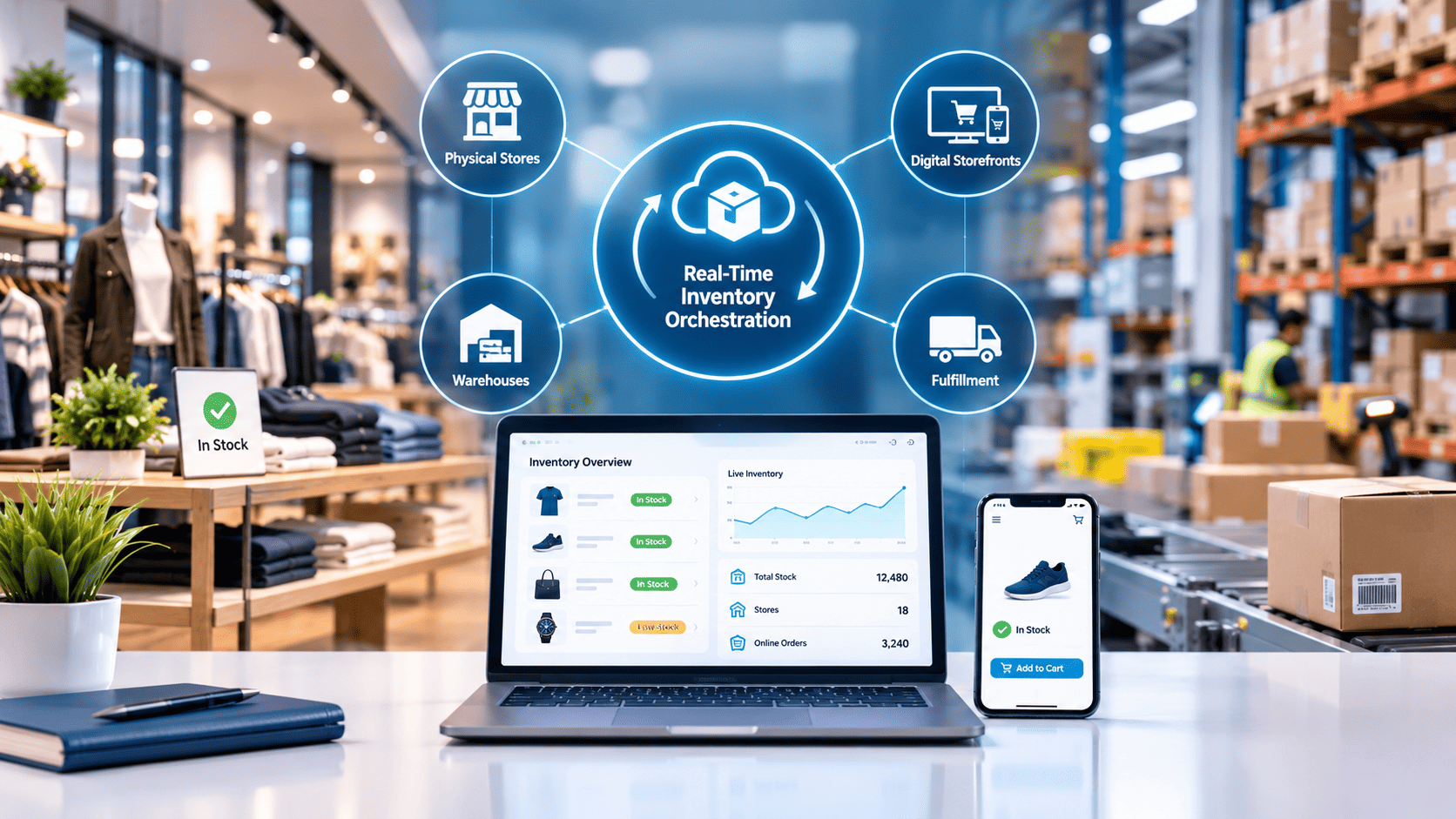
Inventory orchestration coordinates inventory information, reservations, availability rules, fulfillment locations, order routing, and channel updates so that physical and digital commerce operate from a synchronized view of product availability.
The architecture becomes particularly important when retailers introduce BOPIS, ship-from-store, marketplace selling, same-day delivery, endless aisle experiences, and distributed fulfillment.
The objective isn't merely to know where inventory is. It is to determine how that inventory can best be used to fulfill demand.
Why Traditional Inventory Models Struggle With Omnichannel Commerce
Traditional retail inventory architectures were generally designed around a simpler operating model.
A store sold from its own stock.
A warehouse supplied stores.
An ecommerce site sold from a designated fulfillment center.
Each channel could maintain relatively independent inventory processes.
Omnichannel commerce changes that equation.
A customer may discover a product on a mobile device, check availability at a nearby store, purchase online, choose store pickup, and later return the product through a completely different location.
The inventory has effectively become shared infrastructure.
A typical fragmented architecture may look like:
POS → Store Inventory
Ecommerce → Ecommerce Inventory
WMS → Warehouse Inventory
Marketplace → Marketplace Inventory
ERP → Enterprise Inventory
Each system may have accurate information within its own context while the enterprise still lacks a reliable, unified view.
Several problems follow.
Channel-Specific Inventory
When each channel maintains its own inventory representation, stock updates may arrive at different times.
An item sold in a store may not immediately affect ecommerce availability.
Likewise, an ecommerce order may not instantly reduce the quantity available for store-assisted selling.
The problem isn't necessarily that any individual system is incorrect.
The problem is that the systems disagree about the current state of inventory.
Delayed Inventory Updates
Inventory synchronization based on scheduled batches can create windows in which customers see outdated availability.
For low-volume commerce, the delay may be manageable.
For high-demand products, limited releases, promotions, or seasonal products, even a short synchronization gap can create fulfillment problems.
Physical Stores Become Invisible Fulfillment Capacity
A retailer may have thousands of products sitting across physical stores while the ecommerce operation reports the product as unavailable.
The inventory exists.
The organization simply isn't capable of using it efficiently.
That distinction is strategically important.
Store inventory can potentially become a distributed fulfillment network rather than remaining isolated within individual locations.
Overselling Across Channels
Suppose five units remain in a store.
An ecommerce customer purchases two.
A marketplace receives another order.
A customer in the store buys one.
A store associate simultaneously reserves another unit for a customer.
If every channel operates against a slightly different inventory state, the retailer can promise more units than actually exist.
This is where inventory reservation and allocation logic become essential.
What Is Real-Time Inventory Orchestration?
Real-time inventory orchestration is the coordination of inventory data, availability, reservations, fulfillment decisions, and inventory updates across multiple commerce systems and physical locations.
The orchestration layer acts as a decision-making intermediary. Rather than forcing every commerce channel to understand every warehouse, store, reservation rule, and fulfillment constraint, the orchestration layer provides standardized inventory services.
For example, an ecommerce platform might ask:
"Is SKU-1048 available for delivery to this ZIP code?"
The orchestration layer can evaluate:
Available warehouse stock
Nearby store inventory
Existing reservations
Pending orders
Safety stock
Fulfillment rules
Delivery commitments
Store operating status
Channel allocation rules
The response is therefore more useful than simply returning an inventory count.
It can return an actionable availability state.
How Real-Time Inventory Orchestration Works
A modern architecture typically combines several components rather than relying on a single inventory database.
Inventory Data Sources
The first requirement is reliable inventory information.
Sources may include:
POS systems
ERP platforms
Warehouse management systems
Ecommerce platforms
Order management systems
Marketplace platforms
Store applications
Third-party logistics providers
Each system generates inventory-related events. These events become inputs into the orchestration model.
Inventory Availability Service
An inventory availability service provides a consistent interface for applications that need to know whether inventory can be promised.
Instead of every channel querying multiple systems independently, they can request inventory through a common service.
This creates a standardized inventory experience across websites, mobile applications, marketplaces, and store associate tools.
Inventory Reservation
Reservation is one of the most important controls in a real-time inventory architecture.
When a customer begins or completes a purchase, inventory may need to be temporarily reserved.
The exact reservation timing depends on the commerce model, but the principle remains the same:
A customer promise should account for inventory that is already committed elsewhere.
Event-Driven Inventory Updates
Inventory changes can be propagated using events.
For example:
Store Sale
↓
Inventory Event
↓
Inventory Service
↓
Ecommerce Availability
Marketplace Availability
Store Application
Order Management
This reduces reliance on large batch synchronization processes and allows downstream systems to react to inventory changes more quickly.
Connecting Physical Stores With Digital Commerce
The biggest opportunity in real-time inventory orchestration may be the transformation of physical stores into active components of the digital fulfillment network.
A store is no longer only a sales location.
It can become:
A pickup location
A fulfillment node
A return location
A local delivery hub
A customer service point
An endless-aisle extension
A source of inventory for ecommerce orders
This changes the economics of inventory.
A product sitting in a store that isn't selling quickly can potentially satisfy demand from a nearby online customer.
Ship From Store
Ship-from-store allows retailers to fulfill ecommerce orders using inventory located at physical stores.
Instead of:
Customer → Ecommerce → Central Warehouse
the order may follow:
Customer → Ecommerce → Store Fulfillment → Customer
The orchestration engine can evaluate which location is most appropriate based on inventory, distance, fulfillment capacity, shipping requirements, and business rules.
Buy Online, Pick Up In Store
BOPIS requires more than showing store inventory.
The system needs to determine whether inventory is actually available for pickup.
That means distinguishing between:
On-hand inventory
and
Available-to-promise inventory.
A store may physically contain ten units while only seven are available for customer pickup because three are already reserved or allocated.
That distinction prevents misleading availability promises.
Endless Aisle
Store associates can also use digital commerce to sell products that are unavailable in their local store.
A customer might want a particular size or color that isn't physically available.
Rather than losing the sale, the associate can access inventory elsewhere and place an order for delivery.
This turns the entire inventory network into an extension of the store's physical assortment.
The Role of Distributed Order Management
Inventory orchestration becomes significantly more powerful when combined with Distributed Order Management (DOM).
DOM determines how an order should be fulfilled across a network of possible locations.
Consider a customer ordering three products.
The products may not exist together in one warehouse.
The order management system may therefore determine:
Product A → Local Store
Product B → Regional Warehouse
Product C → Central Distribution Center
The customer experiences one order.
Behind the scenes, the fulfillment network executes multiple decisions.
The orchestration layer can consider factors such as:
Inventory availability
Customer location
Delivery promise
Shipping cost
Store capacity
Warehouse capacity
Product restrictions
Business priorities
Inventory aging
Fulfillment cut-off times
This creates a more intelligent relationship between inventory and fulfillment.
Preventing Inventory Overselling
Perfect inventory accuracy is difficult in a distributed retail environment.
Products move constantly.
Customers pick items up from shelves.
Returns enter stores.
Damaged inventory is removed.
Transfers occur between locations.
Orders are canceled.
Therefore, an effective architecture should not assume that inventory is static.
Instead, it should manage inventory as a continuously changing state.
A useful model can distinguish between:
On-Hand Inventory
Physical quantity recorded at a location.
Reserved Inventory
Stock temporarily committed to a customer or process.
Allocated Inventory
Stock assigned to a specific order or fulfillment operation.
Available-to-Promise Inventory
Quantity that can safely be offered to new customers.
Safety Stock
Inventory intentionally protected from customer allocation based on business rules.
These distinctions make availability decisions significantly more reliable than simply displaying raw stock counts.
Protecting Inventory During Traffic Spikes
Flash sales, product launches, seasonal promotions, and viral campaigns can create sudden demand.
The challenge is not only website scalability.
Inventory systems can become bottlenecks as thousands of customers attempt to purchase the same products simultaneously.
A resilient architecture can separate customer-facing traffic from inventory processing.
For example:
10,000 Checkout Requests
↓
Commerce Platform
↓
Inventory Reservation Service
↓
Controlled Inventory Processing
↓
ERP / WMS
This architecture can prevent a legacy ERP or warehouse system from being overwhelmed by every individual customer request.
Caching can also be useful for non-transactional availability reads, while transactional inventory reservations should follow stricter consistency controls.
The distinction matters:
Reading availability and committing inventory are not the same operation.
Handling Inventory Synchronization Failures
Distributed inventory systems must assume that integrations will occasionally fail.
Possible failure conditions include:
POS connectivity problems
ERP downtime
WMS delays
API timeouts
Duplicate events
Out-of-order events
Network failures
Marketplace synchronization errors
Failed inventory reservations
A production architecture should therefore include:
Retry mechanisms
Idempotent processing
Event monitoring
Dead-letter queues
Error alerts
Event replay
Reconciliation processes
Audit trails
Why Idempotency Matters
Suppose an inventory decrease event is processed twice.
Without appropriate controls, the system could reduce available inventory twice.
Idempotent processing ensures that the same event can be safely encountered again without creating an unintended duplicate state change.
This is especially important when inventory events travel through multiple distributed systems.
Inventory Reconciliation Remains Necessary
Real-time architecture does not eliminate the need for reconciliation.
Physical retail introduces realities that software cannot completely control.
A product can be misplaced.
A return may be processed incorrectly.
A damaged item may not be recorded immediately.
A barcode can be scanned incorrectly.
A system integration can fail.
Periodic reconciliation therefore remains an important operational control.
The objective is not to choose between real-time orchestration and reconciliation.
Strong retail architecture uses both.
Real-time events keep systems synchronized during normal operations.
Reconciliation identifies and corrects discrepancies that inevitably occur.
Observability Across the Inventory Network
When inventory is distributed across hundreds or thousands of locations, visibility becomes an engineering requirement.
Retailers should be able to answer questions such as:
Where did an inventory update originate?
When was it processed?
Which systems received it?
Was the event duplicated?
Was inventory successfully reserved?
Why did an order route to a particular location?
Why did an availability promise change?
Which integration failed?
Useful monitoring metrics include:
Inventory event latency
Synchronization failures
Reservation failures
API response times
Queue depth
Event processing throughput
Inventory discrepancies
Order routing failures
Store fulfillment performance
Reconciliation exceptions
Distributed tracing can also connect a customer order to the inventory events and fulfillment decisions associated with it.
Security and Governance for Inventory Orchestration
Inventory information may appear less sensitive than customer or payment information, but it still represents commercially valuable operational data.
Inventory architecture should therefore incorporate:
API authentication
Role-based access controls
Encryption
Secrets management
Audit logging
Network controls
Least-privilege permissions
Service-level authorization
Different users may also require different inventory visibility.
A store associate may need local inventory.
A regional manager may require visibility across multiple locations.
A marketplace integration may only need a specific sellable inventory quantity.
The architecture should expose the right information to the right system rather than treating inventory as universally accessible data.
Common Mistakes in Real-Time Inventory Orchestration
Treating Inventory Visibility as Inventory Orchestration
Simply combining inventory numbers from multiple systems does not create an orchestration capability.
The system must also understand reservations, allocation, fulfillment, and availability rules.
Making Every System Communicate Directly
Point-to-point integrations may work initially but become difficult to maintain as channels and locations increase.
An orchestration layer creates clearer boundaries.
Ignoring Store-Level Operational Reality
A store may technically have inventory but lack the capacity to fulfill online orders.
Fulfillment rules should account for store hours, staffing, order queues, local demand, and operational constraints where relevant.
Treating All Inventory as Sellable
On-hand inventory is not automatically available inventory.
Damaged, reserved, quarantined, allocated, or safety-stock quantities may need to be excluded from customer promises.
Overusing Real-Time Calls
Not every inventory request needs to synchronously query the ERP.
High-volume read operations can often use appropriately designed caching or availability services, while transactional operations require stronger controls.
Ignoring Reconciliation
Even a sophisticated event-driven system requires mechanisms for identifying and correcting discrepancies.
Real-time synchronization reduces the problem.
It doesn't make operational exceptions disappear.
How Radianzz Helps Modernize Inventory Orchestration
Creating a unified inventory ecosystem requires more than connecting an ecommerce platform to an ERP.
At Radianzz, we help retailers evaluate how inventory moves across ecommerce, physical stores, warehouses, marketplaces, order management platforms, and enterprise systems, then identify opportunities to create a more coordinated commerce architecture.
Omnichannel Inventory Strategy
We assess:
Inventory sources
Store networks
Ecommerce platforms
ERP dependencies
WMS integrations
Order workflows
Reservation processes
Marketplace requirements
Fulfillment models
The objective is to create an inventory strategy aligned with the retailer's operating model.
Inventory Integration Architecture
We design integration layers that connect inventory-producing systems with customer-facing commerce channels without forcing every application into direct point-to-point relationships.
Distributed Fulfillment
Retailers can use orchestration logic to support fulfillment models such as:
Ship-from-store
BOPIS
Local fulfillment
Warehouse fulfillment
Marketplace fulfillment
Endless aisle
Real-Time Commerce Experiences
We help connect inventory availability to ecommerce and digital experiences so customers can receive more useful information about product availability, pickup options, and fulfillment choices.
Continuous Optimization
Inventory orchestration should evolve as the business changes.
New stores, marketplaces, fulfillment partners, product categories, and customer experiences can introduce new requirements.
A scalable architecture should make those changes easier rather than creating another layer of integration debt.
Measuring the Success of Inventory Orchestration
Inventory modernization should be evaluated using both technical and commercial metrics.
Inventory Accuracy
Measure the difference between system-recorded inventory and physically verified inventory.
Availability Accuracy
Monitor how frequently the inventory promise shown to customers accurately reflects fulfillment reality.
Order Fulfillment Performance
Track:
Fulfillment time
Order routing accuracy
Store fulfillment success
Pickup readiness
Shipment exceptions
Inventory Utilization
Evaluate whether inventory across stores and warehouses is being effectively used to satisfy demand.
Customer Experience
Relevant indicators can include:
Order cancellations caused by unavailable inventory
Pickup failures
Substitution frequency
Delivery delays
Customer service contacts related to availability
Technical Reliability
Monitor:
Inventory event latency
API failures
Synchronization errors
Reservation failures
Queue processing
Reconciliation exceptions
The strongest measurement framework connects technical performance to business outcomes.
A faster inventory event has limited value if customers still receive inaccurate availability promises.
Conclusion
Retail inventory has changed from a collection of isolated stock pools into a distributed commerce resource.
A product sitting in a store can potentially fulfill an ecommerce order. A warehouse can support marketplace demand. An online order can reserve inventory in a physical location. A store associate can access products that are physically located hundreds of miles away.
But these experiences only work when the underlying inventory architecture can coordinate them.
Real-time inventory orchestration provides that coordination layer.
By connecting POS, ERP, WMS, ecommerce, marketplaces, order management, and physical locations through APIs, events, inventory services, reservation logic, and intelligent fulfillment rules, retailers can create a more unified view of inventory and make better decisions about where and how orders should be fulfilled.
The objective isn't simply:
"Show customers how much inventory we have."
It is:
"Promise customers what we can actually deliver—and determine the smartest way to deliver it."
That distinction is what separates basic inventory synchronization from a truly orchestrated omnichannel commerce operation.
For retailers pursuing unified commerce, the long-term architecture can therefore follow a practical progression:
Connect → Synchronize → Reserve → Orchestrate → Optimize
The result is a retail ecosystem in which physical and digital channels stop competing for inventory visibility and begin operating as coordinated parts of the same commerce network.