

Customer expectations have changed dramatically over the past decade.
Consumers no longer compare your support experience with your direct competitors they compare it with the best experience they've had anywhere. Whether they're shopping online, managing financial accounts, booking travel, or resolving technical issues, they expect immediate responses, personalized interactions, and seamless support across every channel.
Meeting these expectations has become increasingly challenging. Customer support teams are handling higher inquiry volumes, supporting more communication channels, and managing growing demands for speed and accuracy. At the same time, businesses face pressure to control operational costs while maintaining high service standards.
Traditional customer support models, which rely heavily on manual processes and human intervention, often struggle to keep pace with these demands.
Artificial Intelligence (AI) is changing that.
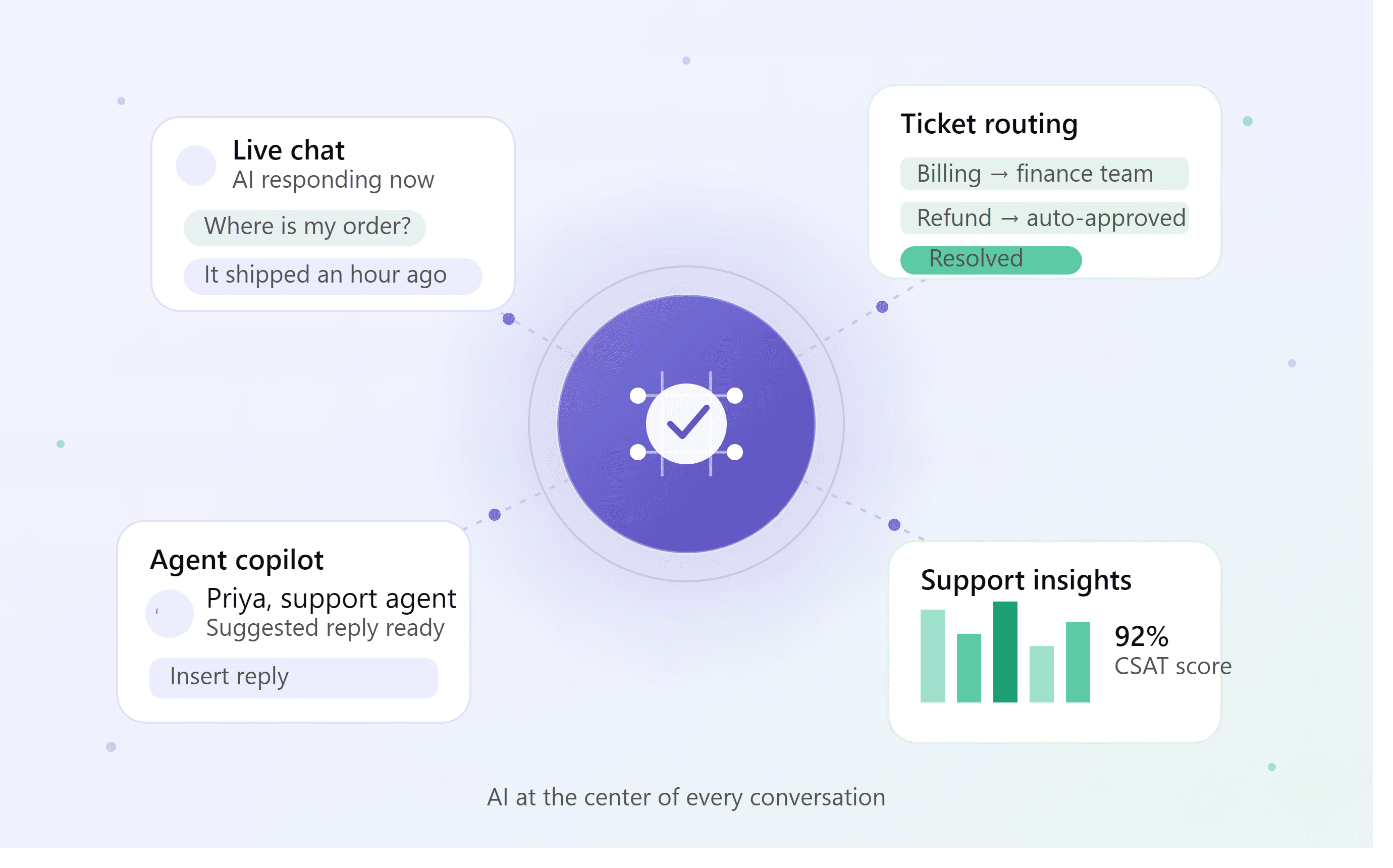
Rather than replacing human agents, AI is enabling organizations to automate repetitive tasks, streamline workflows, provide real-time assistance, and deliver more personalized customer experiences. AI-powered chatbots, virtual assistants, intelligent ticket routing, sentiment analysis, and knowledge management tools are helping support teams work more efficiently while allowing human agents to focus on complex, high-value interactions.
The result is not just faster service it is a fundamental transformation in how businesses engage with customers.
Organizations across ecommerce, retail, healthcare, financial services, manufacturing, telecommunications, and SaaS are increasingly integrating AI into their customer support operations to improve responsiveness, enhance customer satisfaction, and build scalable service models for the future.
In this article, we'll explore how AI is transforming customer support, the technologies driving this evolution, the benefits and challenges organizations should consider, and practical strategies for implementing AI successfully.
Understanding AI in Customer Support
Artificial Intelligence in customer support refers to the use of machine learning, natural language processing (NLP), generative AI, and automation technologies to improve how businesses interact with customers.
Rather than replacing customer service teams, AI augments their capabilities by handling repetitive tasks, analyzing large volumes of customer data, and providing actionable insights in real time.
AI-powered customer support solutions can:
Answer common customer questions instantly
Route inquiries to the appropriate department
Summarize conversations for support agents
Recommend relevant knowledge base articles
Analyze customer sentiment
Translate conversations across multiple languages
Automate repetitive workflows
Assist agents during live interactions
These capabilities allow businesses to deliver faster, more consistent support while improving operational efficiency.
Why Traditional Customer Support Models Are Evolving
Customer support has historically relied on human agents managing inquiries through phone calls, emails, or live chat. While this approach remains essential for complex interactions, it often creates operational challenges as businesses scale.
Rising Customer Expectations
Customers now expect:
Instant responses
24/7 availability
Personalized interactions
Omnichannel support
Self-service options
Consistent experiences across devices
Businesses that fail to meet these expectations risk lower customer satisfaction and reduced loyalty.
Increasing Support Volumes
As businesses expand across digital channels, support requests continue to grow.
Customer inquiries now originate from:
Websites
Mobile applications
Social media
Messaging platforms
Email
Voice calls
Marketplaces
Managing these interactions manually becomes increasingly difficult without automation.
Operational Efficiency
Support teams frequently spend significant time on repetitive tasks such as:
Password resets
Order status inquiries
Appointment scheduling
Product information requests
Refund policies
Shipping updates
Automating these routine interactions allows support agents to focus on issues requiring empathy, judgment, and problem-solving.
Core AI Technologies Transforming Customer Service
Several AI technologies are reshaping customer support operations.
Conversational AI
Conversational AI enables businesses to communicate with customers through natural, human-like conversations using chatbots, virtual assistants, and messaging platforms.
Unlike traditional rule-based bots, modern conversational AI understands intent, maintains context, and delivers more meaningful interactions.
Natural Language Processing (NLP)
NLP allows AI systems to interpret, analyze, and respond to human language.
This technology helps businesses:
Understand customer intent
Detect sentiment
Extract key information
Improve response accuracy
Support multilingual conversations
Intelligent Ticket Routing
AI can automatically categorize support requests based on urgency, topic, customer history, and intent.
Instead of relying on manual assignment, inquiries are routed to the most appropriate support representative or department, reducing response times and improving resolution rates.
AI Agent Assist
AI is increasingly being used to support—not replace—human agents.
During live customer interactions, AI can:
Recommend responses
Surface relevant knowledge articles
Summarize previous conversations
Suggest next-best actions
Generate case notes automatically
This reduces administrative work and allows agents to focus on building stronger customer relationships.
Key Benefits of AI-Powered Customer Support
Artificial Intelligence is no longer just an operational enhancement—it has become a strategic capability that enables businesses to deliver faster, more personalized, and more efficient customer experiences. Organizations that successfully integrate AI into their customer support operations often see improvements in service quality, employee productivity, and customer satisfaction.
Below are some of the most significant business benefits.
Faster Response Times
Customers increasingly expect immediate assistance, regardless of the time of day or communication channel.
AI-powered support systems can instantly respond to common inquiries such as:
Order tracking
Shipping updates
Account information
Password resets
Return and refund policies
Product availability
Appointment scheduling
By resolving these routine questions automatically, businesses can significantly reduce first-response times while ensuring customers receive timely assistance.
The result is a more responsive support experience that meets modern customer expectations.
24/7 Customer Availability
Unlike traditional support teams that operate within business hours, AI-powered virtual assistants remain available around the clock.
Whether a customer reaches out during the day, late at night, or across different time zones, AI can provide immediate support without requiring additional staffing.
This is particularly valuable for:
Global ecommerce businesses
SaaS providers
Financial services
Travel companies
Healthcare organizations
Enterprise software vendors
Continuous availability improves accessibility while reducing customer frustration associated with delayed responses.
Personalized Customer Experiences
Modern AI systems can analyze customer history, preferences, previous interactions, and purchase behavior to deliver more relevant support experiences.
Rather than providing generic responses, AI can personalize conversations by:
Greeting customers by name
Referencing previous interactions
Recommending relevant products or services
Suggesting personalized solutions
Providing contextual assistance
Personalization helps strengthen customer relationships while increasing satisfaction and engagement.
Improved Agent Productivity
One of the greatest misconceptions about AI is that it replaces customer support professionals.
In reality, AI is increasingly being used to assist support teams rather than replace them.
AI enables agents to work more efficiently by:
Summarizing customer conversations
Retrieving relevant documentation
Suggesting responses
Highlighting customer history
Automating after-call summaries
Generating support notes
Recommending next-best actions
By reducing repetitive administrative work, agents can focus on solving complex customer issues and building stronger relationships.
Consistent Customer Experiences
Human responses naturally vary depending on experience, workload, and communication style.
AI helps organizations maintain consistency by ensuring customers receive:
Standardized information
Accurate policy guidance
Consistent workflows
Uniform communication
Reliable responses across channels
Consistency is especially important for regulated industries and businesses operating across multiple support locations.
Smarter Decision-Making Through Data
Every customer interaction generates valuable information.
AI analyzes this data to identify:
Frequently asked questions
Emerging product issues
Customer sentiment trends
Support bottlenecks
Agent performance
Common pain points
These insights enable leadership teams to improve products, optimize workflows, and make informed operational decisions.
Challenges and Governance Considerations
Despite its advantages, implementing AI requires thoughtful planning, governance, and oversight.
Organizations should address several key considerations before deploying AI at scale.
Data Privacy and Security
Customer support interactions often involve sensitive personal and business information.
Businesses should ensure AI solutions comply with applicable data privacy regulations and organizational security policies.
Key considerations include:
Secure data storage
Encryption
Access controls
Customer consent
Audit logging
Data retention policies
Strong governance helps maintain customer trust while reducing organizational risk.
AI Hallucinations and Accuracy
Generative AI systems can occasionally produce inaccurate or misleading responses.
For customer support, this creates potential risks when providing:
Policy information
Technical guidance
Pricing details
Legal information
Product recommendations
Organizations should implement validation mechanisms and maintain human oversight for high-impact interactions.
Human Escalation
Not every customer issue should be handled by AI.
Complex situations involving:
Billing disputes
Technical troubleshooting
Sensitive complaints
Contract negotiations
Account security
High-value customers
often require human judgment, empathy, and problem-solving.
Successful AI strategies ensure customers can transition seamlessly from automated support to human agents whenever necessary.
Continuous Learning and Optimization
AI is not a "set it and forget it" technology.
To remain effective, AI systems should be continuously monitored and improved through:
Customer feedback
Performance analytics
Knowledge base updates
Prompt optimization
Workflow improvements
Regular testing
Ongoing optimization ensures AI continues to deliver accurate, relevant, and valuable support experiences.
Best Practices for Implementing AI in Customer Support
Organizations that achieve the greatest success with AI typically follow a phased, customer-centric approach rather than attempting large-scale transformations all at once.
Start with High-Volume, Repetitive Tasks
Identify support requests that occur frequently and follow predictable workflows, such as order tracking, FAQs, password resets, or account inquiries. Automating these interactions delivers quick wins while freeing agents to focus on more complex cases.
Build a Reliable Knowledge Base
AI performs best when it has access to accurate, well-structured information. Regularly update product documentation, FAQs, policies, and troubleshooting guides to ensure responses remain consistent and trustworthy.
Maintain Human Oversight
AI should augment human expertise, not replace it. Establish clear escalation paths so customers can easily connect with a support representative whenever AI cannot confidently resolve an issue.
Monitor Performance Metrics
Track key performance indicators such as:
First Response Time (FRT)
Average Resolution Time (ART)
First Contact Resolution (FCR)
Customer Satisfaction (CSAT)
Net Promoter Score (NPS)
Ticket Deflection Rate
Escalation Rate
These metrics help identify opportunities for continuous improvement.
Integrate AI Across Business Systems
To maximize value, AI should connect seamlessly with existing business applications such as CRM, ERP, ecommerce platforms, order management systems, and customer knowledge bases. Integrated systems provide AI with richer context, enabling more accurate and personalized support.
The Future of AI in Customer Support
AI continues to evolve rapidly, and customer support is expected to become even more intelligent, proactive, and personalized over the coming years.
Emerging trends include:
AI Agents That Execute Business Tasks
Rather than simply answering questions, AI agents will increasingly complete end-to-end workflows such as processing refunds, updating customer records, scheduling appointments, and initiating returns—reducing manual effort while improving operational efficiency.
Predictive Customer Support
By analyzing historical interactions, purchasing behavior, and product usage, AI will anticipate customer needs before issues arise, enabling businesses to resolve potential problems proactively.
Voice AI and Multimodal Support
Future customer support experiences will combine voice, text, images, and video into unified conversations, allowing customers to interact using the communication method most convenient for them.
Hyper-Personalized Experiences
AI will leverage customer preferences, purchase history, browsing behavior, and real-time context to deliver highly individualized support experiences that strengthen loyalty and improve engagement.
Human-AI Collaboration
The most successful organizations will not replace human agents—they will create collaborative environments where AI handles repetitive tasks while employees focus on empathy, relationship building, and complex problem-solving.
How Radianzz Helps Businesses Transform Customer Support with AI
Delivering exceptional customer support requires more than deploying a chatbot. It involves designing intelligent systems that integrate seamlessly with your business processes, customer data, and digital ecosystem.
At Radianzz, we help organizations build AI-powered customer support solutions that improve operational efficiency while enhancing customer experience.
Our AI & Customer Experience Services Include:
AI Strategy & Consulting
Developing AI adoption roadmaps aligned with business objectives, customer experience goals, and operational requirements.
AI Copilot Development
Building intelligent copilots that assist support teams with knowledge retrieval, case summarization, recommended responses, and workflow automation.
Conversational AI Solutions
Designing AI-powered chatbots and virtual assistants capable of delivering natural, contextual conversations across websites, mobile apps, and messaging platforms.
Customer Support Automation
Automating repetitive support workflows, ticket classification, routing, notifications, and self-service capabilities.
AI Integration Services
Connecting AI platforms with CRM, ERP, ecommerce systems, help desk software, and enterprise applications to create a unified customer experience.
Knowledge Management Solutions
Building centralized knowledge repositories that enable AI systems to deliver accurate, up-to-date responses while empowering customer support teams.
Performance Optimization
Monitoring AI performance, refining prompts, improving workflows, and continuously optimizing customer interactions to maximize business value.
Conclusion
Artificial Intelligence is fundamentally changing how businesses deliver customer support.
By automating routine interactions, assisting human agents, analyzing customer behavior, and enabling faster decision-making, AI allows organizations to provide more responsive, personalized, and scalable service experiences.
However, successful AI adoption is not simply about implementing new technology. It requires a thoughtful strategy that combines intelligent automation with human expertise, robust governance, and continuous optimization.
Organizations that embrace AI as a tool to enhance—not replace—their customer support teams will be better positioned to improve customer satisfaction, increase operational efficiency, and build stronger, long-term relationships.
As customer expectations continue to evolve, AI-powered customer support is becoming a competitive necessity rather than an optional innovation.