

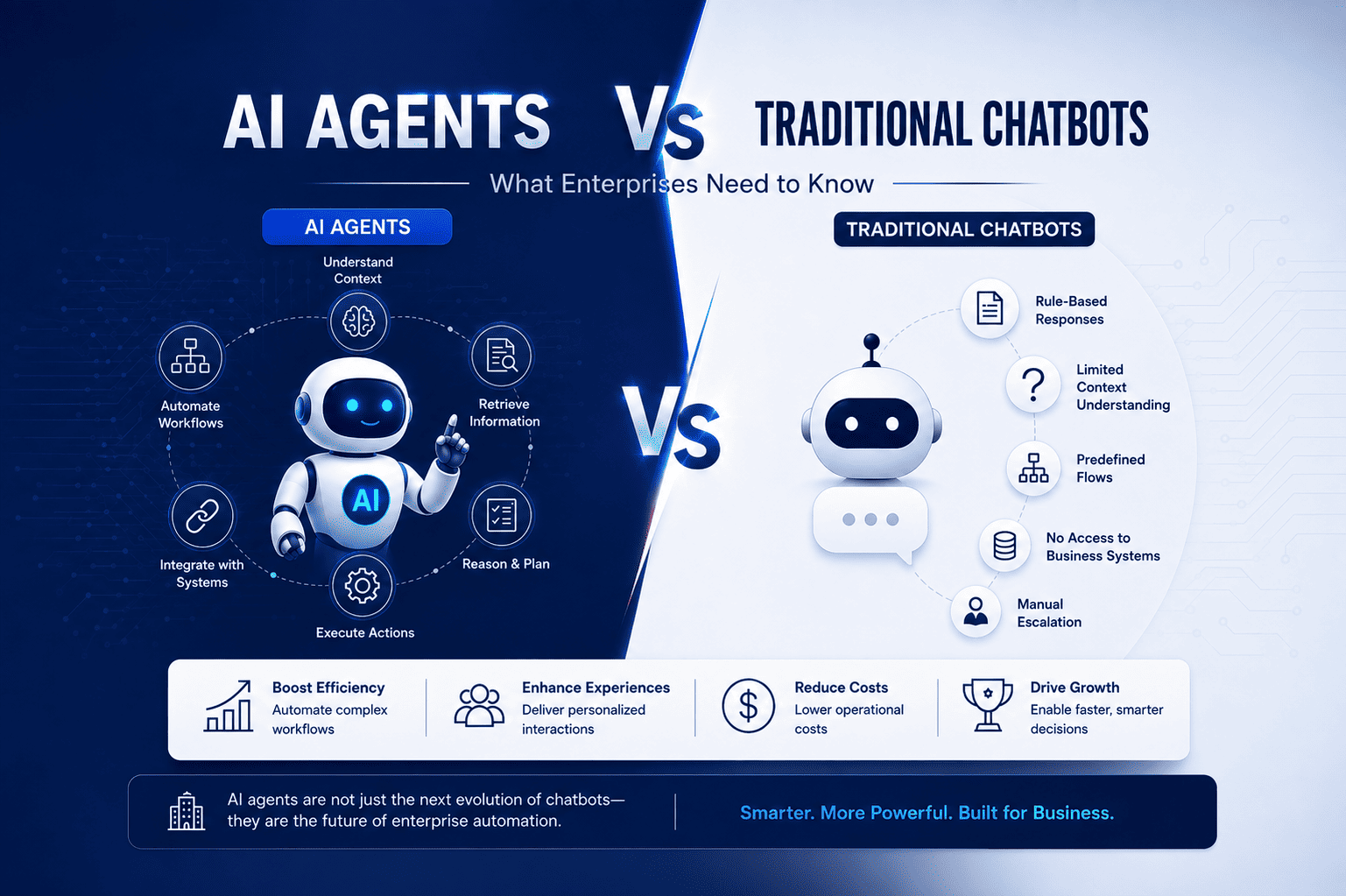
Artificial Intelligence has rapidly moved from experimentation to business-critical implementation. Over the past decade, organizations have deployed chatbots to automate customer interactions, answer frequently asked questions, and reduce support workloads. While these solutions delivered operational benefits, they often struggled to handle complex customer requests or adapt to changing business needs.
Today, a new generation of AI-powered systems is emerging.
AI agents are transforming how businesses automate workflows, support employees, engage customers, and drive operational efficiency. Unlike traditional chatbots, AI agents can understand context, retrieve information, reason through problems, execute tasks, and interact with multiple business systems. Despite growing interest in AI, many organizations still use the terms "AI agent" and "chatbot" interchangeably.
Understanding the distinction is critical because the difference directly impacts business outcomes, scalability, customer experience, and return on investment.
In this article, we'll explore how AI agents differ from traditional chatbots, where they create value, and what organizations should consider before deploying them.
What Is a Traditional Chatbot?
A traditional chatbot is a software application designed to simulate conversations with users through predefined rules or scripted interactions.
Most early-generation chatbots operate using:
Decision trees
Rule-based logic
Keyword matching
Predefined conversation flows
Their primary goal is to automate simple, repetitive interactions.
Examples include:
Order tracking requests
Password reset instructions
Business hours inquiries
FAQ responses
Basic appointment scheduling
While these systems can be effective for handling routine questions, they have significant limitations.
Limited Understanding
Traditional chatbots do not truly understand context.
They typically match user inputs against predefined responses.
When a conversation deviates from expected patterns, the chatbot often fails to provide useful answers.
For example:
Customer:
"I need help changing my delivery address because my order hasn't shipped yet."
Traditional Chatbot:
"Please select one of the following options:
Track Order
Return Product
Contact Support"
The chatbot cannot interpret the nuance of the request or determine the best course of action.
Rule-Based Constraints
Every conversation path must be manually configured.
As complexity increases, maintaining chatbot logic becomes increasingly difficult.
Organizations often face:
Large decision trees
High maintenance costs
Poor customer experiences
Limited scalability
Lack of Business Context
Traditional chatbots typically operate independently of business systems.
They may not have access to:
Customer history
Order information
Product inventory
CRM records
Internal knowledge bases
As a result, they struggle to provide personalized or contextual responses.
What Is an AI Agent?
An AI agent is an intelligent software system capable of understanding requests, retrieving relevant information, reasoning through tasks, and taking action on behalf of users.
Unlike traditional chatbots, AI agents are designed to support decision-making and workflow execution rather than simply answering questions.
Modern AI agents combine several technologies:
Large Language Models (LLMs)
Knowledge Retrieval Systems
Business Integrations
Workflow Automation Engines
Context Management Frameworks
Together, these capabilities allow AI agents to function more like digital coworkers than conversational interfaces.
Context Awareness
One of the most important capabilities of AI agents is context awareness.
AI agents can maintain conversational history and understand user intent across multiple interactions.
For example:
Customer:
"My package hasn't arrived."
AI Agent:
"I see your order was shipped three days ago and is currently delayed due to weather conditions. Would you like me to notify you when delivery is scheduled?"
The AI agent understands the request, retrieves order data, and provides a contextual response.
Knowledge Retrieval
Modern AI agents can access and interpret information from multiple sources.
These may include:
Internal documentation
Knowledge bases
Product catalogs
CRM systems
Policy documents
Training materials
Rather than relying on static responses, AI agents retrieve relevant information in real time.
This significantly improves accuracy and usefulness.
Multi-Step Reasoning
Traditional chatbots generally respond to one request at a time.
AI agents can break down complex tasks into multiple steps.
For example:
Employee Request:
"Create a summary of our top support issues last month and recommend areas for improvement."
An AI agent may:
Access support ticket data
Analyze recurring themes
Identify trends
Generate insights
Produce a report
This level of reasoning transforms AI from a communication tool into a productivity tool.
Workflow Automation
Perhaps the most significant difference is the ability to execute actions.
AI agents can:
Create tickets
Update records
Trigger workflows
Generate reports
Route requests
Schedule appointments
Process approvals
Rather than simply providing information, they can complete work.
This capability creates substantial operational value.
Enterprise Use Cases for AI Agents
Organizations across industries are deploying AI agents to improve efficiency, reduce costs, and enhance customer experiences.
Below are some of the most impactful use cases.
Customer Support Automation
Customer support remains one of the most common applications of AI agents.
Traditional support teams often spend significant time handling repetitive inquiries such as:
Order tracking
Account updates
Return requests
Product questions
AI agents can automate these interactions while providing personalized responses based on customer data.
Benefits include:
Faster response times
Lower support costs
Improved customer satisfaction
Increased agent productivity
Sales Operations
Sales teams often spend valuable time on administrative activities.
AI agents can assist by:
Qualifying leads
Scheduling meetings
Updating CRM records
Generating account summaries
Drafting sales communications
This allows sales professionals to focus on relationship building and revenue generation.
Internal Knowledge Assistants
Large organizations frequently struggle with knowledge management.
Employees spend significant time searching for information across:
Documents
Wikis
Emails
Shared drives
AI-powered knowledge assistants provide instant access to organizational information.
Employees can ask questions in natural language and receive relevant answers immediately.
This improves productivity and reduces information silos.
Ecommerce Automation
Ecommerce businesses are increasingly adopting AI agents across multiple functions.
Common use cases include:
Customer Service
Automating inquiries related to orders, shipping, returns, and product recommendations.
Product Discovery
Helping customers find products based on preferences and purchasing intent.
Inventory Assistance
Providing real-time stock availability information.
Personalization
Recommending products and content tailored to individual customers.
Post-Purchase Support
Managing customer engagement after purchase.
These capabilities improve both operational efficiency and customer experience.
Risks and Governance Considerations
While AI agents create significant opportunities, organizations must also address potential risks.
Successful AI implementation requires governance, oversight, and clear accountability.
Hallucinations and Accuracy
Large Language Models occasionally generate inaccurate information.
This phenomenon is commonly referred to as hallucination.
Potential risks include:
Incorrect customer information
Policy violations
Compliance concerns
Reduced trust
Organizations should implement validation mechanisms and retrieval-based architectures to improve reliability.
Security and Data Privacy
AI systems often interact with sensitive business information.
Organizations must ensure:
Access controls
Data encryption
Audit trails
Compliance requirements
Enterprise-grade AI solutions should align with security and governance standards.
Human Oversight
Not every decision should be automated.
High-impact activities often require human review.
Examples include:
Financial approvals
Legal decisions
Escalated customer disputes
Regulatory compliance matters
The most effective AI systems combine automation with human supervision.
Building AI Agents That Deliver Business Value
Many AI projects fail because they prioritize technology rather than business outcomes.
Successful implementations begin with identifying clear business problems.
Organizations should focus on:
Defining Specific Use Cases
Start with measurable opportunities.
Examples:
Reduce support costs
Improve response times
Increase employee productivity
Accelerate workflows
Integrating Business Systems
AI agents become significantly more valuable when connected to operational systems.
Key integrations may include:
CRM platforms
Ecommerce systems
ERP solutions
Knowledge bases
Support platforms
Implementing Governance Frameworks
Establish processes for:
Monitoring performance
Managing risk
Reviewing outputs
Maintaining compliance
Continuous Optimization
AI is not a one-time implementation.
Organizations should continuously evaluate:
User feedback
Performance metrics
Automation accuracy
Business outcomes
Continuous improvement drives long-term value.
Why AI Agents Are Becoming a Competitive Advantage
Organizations that successfully deploy AI agents gain more than operational efficiency.
They create competitive advantages through:
Faster Customer Service
Reduced response and resolution times.
Lower Operating Costs
Automation of repetitive activities.
Improved Employee Productivity
Less time spent on manual work.
Better Customer Experiences
More personalized and contextual interactions.
Scalable Operations
Ability to handle growth without proportional increases in headcount.
As AI capabilities continue to evolve, businesses that invest strategically will be better positioned to compete in increasingly digital environments.
How Radianzz Helps Organizations Implement Enterprise AI Solutions
Building effective AI systems requires more than selecting a model.
Successful AI initiatives combine strategy, architecture, governance, integrations, and continuous optimization.
Radianzz helps organizations accelerate AI adoption through:
AI Strategy & Consulting
Identifying high-value automation opportunities and implementation roadmaps.
AI Agent Development
Designing intelligent systems capable of supporting business workflows and customer interactions.
AI Copilot Development
Building AI-powered assistants for employees, support teams, and operational functions.
Workflow Automation
Connecting AI agents with enterprise systems to automate business processes.
AI Governance & Optimization
Establishing monitoring frameworks and performance improvement strategies.
Related Services:
AI Automation Services
Custom Software Development
Digital Transformation Consulting
Customer Experience Solutions